Sunday, September 05, 2004

Luke 14: 26—Put The Rock In The Jar First!

(Twenty-third Sunday of the Year (C): This homily was given on September 5, 2004 at St. Pius X Church, Westerly, R.I. Read Luke 14: 25-33.)

[For the audio version of this homily, click here: Twenty-third Sunday 2004]


Jesus said, “If anyone comes to me without hating his father and mother, wife and children, brothers and sisters, and even his own life, he cannot be my disciple.”

Dear Jesus, what are you talking about? I thought you told us to love one another as you have loved us?

Perhaps the story of the rock, the pebbles, and the sand will help us to understand what the Lord is actually saying to us in this difficult verse from Luke 14. Some of you may have heard this before. . . .

One day a theology professor at a Catholic university brought several special items into his classroom: a large, clear glass jar, a rock, a box of pebbles, and a box of sand.

He stood before his students, and, without saying a word, he put the rock inside the jar. Then he added the pebbles—as many as he could fit into the remaining space. Finally he poured in the sand, which filled in all the small areas between the rock and the pebbles.

Then he said to the students, “I’ve just given you a visual example of how God wants you to live on this earth. This jar represents your life; the rock represents Jesus Christ and your Catholic faith. These must always be your first priorities! You were made to know God, to love God and to serve God during the years the Lord gives you on this planet. Your Catholic faith teaches you how to do this; it teaches you how to know and follow God’s will.

“The pebbles represent the other important dimensions of your life: your marriage (if you’re married), your children, your family, your other interpersonal relationships, your daily responsibilities, your job, your works of charity, your physical health, etc.

“Finally, the sand represents all the ‘small stuff’—the trivialities that most of us, quite frankly, are much too concerned with: the clothes we wear, our social status, the car we drive, the number of ‘toys’ we have, whether people like us or not, etc.

“Notice I put the rock in the jar first. If I hadn’t done that—if I had started off by filling the jar with pebbles or sand or some combination of the two—there would not have been room for the rock. And that’s the way life is: If we fill it with sand and pebbles (as important as some of those pebbles might be!) we won’t have enough room for Christ. He must be first—our faith in him and in his truth must be primary. Then we can add the pebbles and the sand—in that order, of course! The pebbles must be put in before the sand!”

Listen again now to what Jesus said: “If anyone comes to me without hating his father and mother, wife and children, brothers and sisters, and even his own life, he cannot be my disciple.”

To hate in this context means “to put into a subordinate place”; it doesn’t mean “to detest.” It couldn’t possibly mean that, because in other passages of Scripture Jesus forbids hatred—even of our enemies!

The message of our Lord in this verse could be paraphrased in this way: “If anyone comes to me without putting me first in his life and placing all his other human relationships in a secondary position, he cannot be my disciple.”

The Rock in other words, must be placed in our jar first! (Rock here has a capital “R.” The “Rock” is Christ!) He must occupy the central and primary position—regardless of who we are and what our state of life happens to be.

This involves more than just saying, “Jesus, I love you; you’re my Savior; you’re number 1!” Putting the Rock in the jar first also means making every effort to obey Jesus perfectly—the Jesus who speaks to us through his word, as taught authoritatively by his Church!

Is this easy? No, it is not! Consider, for example, the Catholic political figures in our nation right now who happily profess their love for Jesus, and then openly oppose our Lord’s Gospel through their public support of abortion, the gay lifestyle, embryonic stem cell research, and a host of other moral evils!

Most of them do this because they think it will get them votes from the members of NARAL and the National Organization for Women and every other radical, leftist group out there. But in compromising their faith in this way, these political figures are actually putting their human relationships with the members of these organizations above their relationship with Jesus Christ!

Do some of these same Catholic politicians support other causes which are noble and just? In many cases, the answer is yes! But that’s like putting pebbles in the jar and leaving out the Rock! Jesus said, “If anyone comes to me without putting me first in his life and placing all his other human relationships—and we might add all his ‘issues’—in a secondary position, he cannot be my disciple.”

And here’s the interesting irony for you to ponder during this election year: If a Catholic politician puts the Lord first in his life, and “hates” his constituents in the sense that Jesus uses the term here, he will end up becoming a better, stronger, more compassionate leader!

I don’t know about you, but I tend to trust a politician much more if he has respect for the commandments of God, and respect for the most innocent and vulnerable among us: the unborn, the elderly, the terminally ill, etc.

If a government official spurns God’s law and demonstrates a lack of respect for most innocent and vulnerable in our society, then I certainly don’t think he’ll respect me and my rights—because I’m not so “innocent and vulnerable”! And neither are most of you!

But let’s be clear about it, this truth applies to everyone, not just politicians! In her incredible life, for example, Blessed Mother Teresa clearly put Jesus Christ first; there’s little or no doubt about that. At the same time she “hated” the sick and dying souls of Calcutta—in the sense that they took second place in her heart. But because of that she loved them more! By making the daily decision to put Jesus first, she allowed her heart to be filled with his love continually—and it was that love which inspired her great acts of charity and mercy.

My mother, God rest her soul, always told my father, my sister and me that Jesus Christ was her first love. And she meant it! In that sense she “hated” us. But because she hated us in this way she loved us much more than she would have if her commitment to Jesus had been mediocre or non-existent.

My mother, like Blessed Mother Teresa, put the Rock in the jar first—and kept it there.

May the Lord help each of us—and every Catholic—to do the same.

Sunday, August 15, 2004

The Assumption of Mary: It Reminds Us That Heaven is for the Holy!

(Assumption 2004: This homily was given on August 15, 2004, at St. Pius X Church, Westerly, R.I. Read Revelation 12: 1-10; Luke 1: 39-56.)

[For the audio version of this homily, click here: Assumption 2004]


A priest was saying Mass for some young children one Sunday, and during the homily he said to them, “How many of you want to go to heaven someday? If you want to go to heaven, raise your hand.”

Every little hand immediately went up.

Then the priest said, “And how many of you want to be saints?”

The children began to look at one another quizzically; a few scratched their heads; and eventually most of them put their hands down.

The priest said, “Well, that’s a problem, boys and girls, because only saints go to heaven! So let me ask you one more time, ‘How many of you want to be saints?’”

Not surprisingly, all the hands went up again!

That’s a true story; it really happened. And it shouldn’t surprise us, because those little children were thinking just like many adults think. You see, in the minds of many adults today there is very little if any connection between holiness and heaven. The link between those two realities has been almost completely severed. Consequently, they talk as if heaven is open to everyone, no questions asked.

But that’s not true! As those little children learned that Sunday, heaven is for the holy—and only for the holy! It’s for those who have been made holy by union with Jesus Christ in Baptism, and who have been purified of every subsequent sin they ever committed and every sinful attachment they ever experienced! The Book of Revelation says, “Nothing profane shall enter [God’s kingdom].” Nothing! That’s why the author of Hebrews urges us to “Strive for that holiness without which no one can see the Lord.”

A couple of weeks ago I went to a funeral at another parish, and the priest giving the homily said that he knew the deceased woman was now in heaven. He never mentioned hell. Nor did he mention purgatory (which he should have!)—not even as a remote possibility!

He said what he said in an attempt to console the family, but what he ended up doing was trivializing heaven!

No wonder we don’t get excited about the idea of going there! Face it, in the minds of many people heaven is nothing more than a boring imitation of earth, where people float around with harps and pray all the time.

But that’s not how St. Paul described it! He said, “Eye has not seen, ear has not heard, nor has it so much as dawned on man what God has prepared for those who love him.”

Is there prayer and worship in heaven? Of course there is! With one difference: In heaven the saints see God face to face when they worship. That rules out boredom! As St. Paul put it, “Now [i.e. here, on earth] we see indistinctly, as in a mirror; then we shall see face to face.”

If we are among those who trivialize heaven, then today’s feast will mean little or nothing to us. It’s only when we begin in some small way to appreciate the true blessings of God’s eternal kingdom—it’s only then that Mary’s Assumption gives us real joy and real hope.

St. John in today’s first reading from Revelation 12 sees a vision of a woman in heavenly glory who gives birth to the Messiah. This text points us to the reality of Mary’s Assumption. She is that woman in glory!

In today’s Gospel text from Luke 1 Mary calls God her Savior, and says that God has done great things for her.

The dogma of the Assumption teaches us that at the end of her life Mary was taken up, body and soul into God’s eternal kingdom. This—along with her Immaculate Conception—was Mary’s personal experience of salvation.

It would also be true to say that the Assumption was the ultimate reward of Mary’s personal holiness! It was God’s greatest gift to her. Remember, heaven is for the holy! By the grace of God, Mary was sinless; she was perfectly faithful and holy; thus, she was ready for heaven the very moment her life on this earth came to an end.

The Assumption of Mary also reminds us of the ultimate destiny of the saints! As she is right now, so shall all the saints be at the end of time when their souls are reunited with their bodies. And the good news is, we are all called “to be in that number” as the old song goes “when [those] saints go marching in.”

Can you think of a better reason to examine your conscience every day?

Can you think of a better reason to go to Confession if you miss Mass or commit some other mortal sin?

Can you think of a better reason to get your marital situation straightened out if you’re presently married outside the Church?

Can you think of a better reason to pray and to work at improving your relationship with God every day?

Maybe you can. But, quite frankly, I can’t!

Sunday, August 08, 2004

The Reasonableness of Faith

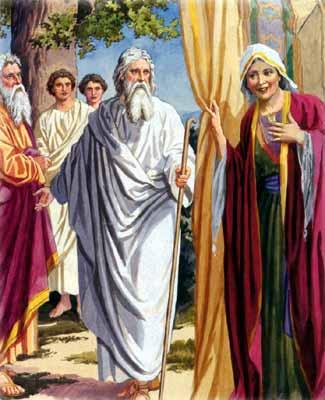
Abraham and Sarah

(Nineteenth Sunday of the Year (C): This homily was given on August 8, 2004, at St. Pius X Church, Westerly, R.I. Read Hebrews 11.)

[For the audio version of this homily, click here: Nineteenth Sunday 2004]


Faith or reason—which is it?

Are you a person who lives by faith, or do you use your intellect and live by reason?

That’s the way the issue is typically framed in our modern culture. And so people are either labeled “religious” or “scientific”—as if religious people don’t have intellects, and people of science never act on faith!

Wrong on both counts!

For example, every scientific, “rational” atheist has faith, whether he realizes it or not! First of all, he has faith that God does not exist, because the existence of God is not something which can be proven or disproven by the scientific method!

But he also has faith in lots of other things.

If he’s married, ask him the question, “Does your spouse love you?” If he says yes, then ask him how he knows that. Has he demonstrated it scientifically? Has he run a series of experiments to validate the hypothesis? Of course not! Because the existence of love is not something which can be proven by science!

Ultimately, it’s a matter of faith! The married atheist, like the married believer, has faith that his spouse loves him. Now I’m sure he has some good reasons for his belief—but it’s still belief!

Ask him if Abraham Lincoln or Julius Caesar or Aristotle ever existed. If he says yes, then ask him once again how he knows this. It’s not because he saw these people with his own eyes and verified their existence experientially! No! He has faith in the men and women who wrote the history books he read in school! He has faith that they knew what they were talking about, and that they were telling him the truth!

Do you realize that every time you put a bite of prepared food into your mouth, you act on faith? (And, of course, depending on who’s prepared the meal, there may be a lot of faith involved!) I say this, because, unless you carry a “food testing machine” with you wherever you go, you don’t know with absolute certitude that the food you’re eating at a given meal isn’t spoiled or laced with poison!

I could go on with many other examples, but I think I’ve made my point. Everyone, to some extent, lives by faith! That’s a fact. Even the most “rational” person on the planet does things by faith each and every day!

So faith must be reasonable, since reasonable people have faith!

In today’s second reading, from Hebrews 11, we hear about the faith of some of the great figures of the Old Testament. In this context, of course, the object of their faith wasn’t anything or anyone on this earth: it was almighty God himself. Abraham, Sarah (and the other Old Testament figures mentioned in this chapter—Abel, Noah, Isaac, Moses, etc.), put their faith in God and were blessed by him in some tangible way.

All of them believed—but not foolishly or blindly! All of them had reasons for their belief, reasons for their faith!

A married man has reasons why he believes his wife loves him. We all have reasons for believing what we read in history books. We have reasons why we believe that the food we’re about to eat at a given meal is safe and healthy.

It says in this text that Abraham put his faith in God and was willing to offer up his son Isaac, because (and here I quote), “He reasoned that God was able to raise even from the dead . . . “

That was one reason for his faith. I’m sure he had many others as well.

We should also have reasons—intelligent, rational reasons—why we believe in God, and why we believe in the teachings of his one, holy, catholic and apostolic Church!

So what are yours?

Why do you believe?

I’ll leave you to ponder that question. Think about it during the coming week. Ask yourself, “Why do I believe?” You might even consider writing down your answers and sharing them with a close Catholic friend.

Then challenge him as to why he believes!

And don’t be surprised if your faith grows a little stronger in the process. Reflecting on the reasons for your faith, may actually help to deepen your faith. And I think we’d all agree that, in these troubled times, a deeper personal faith is always a great blessing.

Sunday, August 01, 2004

A Brief Lesson on the Psychology of Greed

(Eighteenth Sunday of the Year (C): This homily was given on August 1, 2004 at St. Pius X Church, Westerly, R.I. Read Colossians 3: 1-11; Luke 12: 13-21.)

[For the audio version of this homily, click here: Eighteenth Sunday 2004]


“Teacher, tell my brother to share the inheritance with me.”

A family fight over an estate. Sound familiar?

Some things don’t change in 2,000 years, do they?!

Jesus used this occasion to give a short but very clear teaching on the subject of greed, a teaching that he illustrated with a parable about a rich man who had a bountiful harvest.

Greed, of course, is one of the seven deadly sins. It’s very common—as common as family arguments over the property of deceased loved ones! And greed can also be subtle—extremely subtle.

For example, here’s an interesting statistic that some of you might not be aware of (I read it on-line the other day): “Rhode Island leads the nation in per-capita spending on lottery-sponsored gambling, at nearly $1,200 per person in fiscal 2003, according to the North American Association of State and Provincial Lotteries.”

And now some of our citizens want a casino!

When will it end? Will it ever end—before THE END?

Of course, the deeper and more important question is: Why this attraction to gambling?

Well, for some, gambling might be a relatively harmless form of recreation undertaken with a few dollars—please hear that: a “few” dollars!—of disposable income.

But, let’s be honest about it, for all too many, it’s greed that drives them to gamble, and gamble heavily!

Today I offer you a brief lesson on the psychology of greed:

Greed is rooted in the desire to possess—which is not a bad desire, in and of itself.

We have this desire because we are finite, imperfect human beings; thus we want to possess those realities that we think will make us more complete as persons and bring us closer to perfection.

The mistake the greedy person makes is that he channels this desire toward the wrong objects! He channels his desire “to possess” toward the things of this world.

Now this is a mistake for two reasons. Number one, we will never, ever have enough of this world’s goods to satisfy us; and, number two, if we’re consumed with a desire for money and material possessions, we will probably neglect our immortal soul in the process, and put our eternal salvation in jeopardy.

Look at the rich man in this parable we just heard. He had more than enough grain and other goods for himself and his own needs, but he still wasn’t satisfied. In his greed he wanted more! So decided to tear down his barns and build bigger ones to store all his “stuff.”

At the same time, he obviously was neglecting the state of his soul. Which is why God said to him, “You fool, this night your life will be demanded of you; and the things you have prepared, to whom will they belong?”

Now here’s an important fact: The great saints of the Church had a desire “to possess” that was just as strong as this rich man’s was, with one very big difference: their desire to possess was directed toward the things of God and not toward the things of this world.

They desired “to possess” realities like virtue, goodness, love and holiness. Consider St. Paul; he had this desire in abundance. That’s crystal clear from today’s second reading from Colossians 3. And he wanted all of us to have this same desire. He said in that text, “Brothers and sisters: If you were raised with Christ, seek what is above, where Christ is seated at the right hand of God. Think of what is above, not of what is on earth. . . . Put to death, then, the parts of you that are earthly: immorality, impurity, passion, evil desire and the greed that is idolatry.”

We all experience the desire to have, the desire to possess. It’s part of our human nature. To what are we directing this desire at the present time? Are we directing it toward the things of this world, or toward the things of the Lord?

That’s the key question of the day. May we all have the courage to answer it honestly, and to make any changes we need to make, so that we will become rich (as Jesus would say) “in what matters to God.”