Sunday, August 02, 2009

Our Spiritual Motives

(Eighteenth Sunday of the Year (B): This homily was given on August 2, 2009 at St. Pius X Church, Westerly, R.I. by Fr. Raymond Suriani. Read John 6: 24-35.)

[For the audio version of this homily, click here: Eighteenth Sunday 2009]


One day a priest was giving a homily on the miracle of the loaves and fish, but he had left his notes in the rectory. So in the middle of talk he got confused, and instead of saying that Jesus fed 5,000 people with 5 barley loaves and 2 fish, he said, “The Lord used 3,000 barley loaves and 1,000 fish to feed 25 people. And they had plenty of food left over.”

At that point a heckler in the congregation yelled out, “Father, that’s no miracle! Anybody could do that!”The priest said, “Could you?” The heckler said, “Of course!”

After Mass the priest complained to his deacon about the heckler, and the deacon told him about the mistake he had made in the homily.

The priest said, “I can’t believe I did that. Well, don’t worry, I’ll straighten everything out next week.”

So the following Sunday the priest started off his homily by saying, “Today I’d like to continue talking about the miracle of the loaves and fish, but I want to make it clear that Jesus actually fed 5,000 hungry people with only 5 barley loaves and 2 little fish.” At that point he spotted the heckler in the first pew and he said to him, “And could you do that?”

The man said, “Of course. No problem.”

The priest said, “Oh yeah? How?”

The man replied, “That’s easy. I’d use the leftover bread and fish from last Sunday!”

The miracle of the loaves and fish is one of the best known in all of Scripture. Here at St. Pius we have it portrayed beautifully in one of our stained glass windows.

But why did Jesus do it—aside from the fact that he loved these people and didn’t want them to go away hungry? That, I think, is a key question, since Jesus never did anything without a good reason.

The answer can be discerned from today’s gospel passage, which comes almost immediately after the story of the miracle in John, chapter 6. (You will recall that the story of the miracle itself was the gospel passage from last Sunday.)

According to St. John, after the people had been fed this miraculous meal, Jesus and his disciples left the area, eventually ending up in Capernaum, on the other side of the Sea of Galilee.

The people—or at least many of them—followed. When they finally tracked the Lord down, they asked him when he had gotten there.

Jesus responded with these words: “You are looking for me not because you saw signs but because you ate the loaves and were filled. Do not work for food that perishes but for the food that endures for eternal life, which the Son of Man will give you.”

From those two sentences, from those two short verses, we can figure out why Jesus performed this miracle. Simply put, he did it as a means to an end. He gave the people a miraculous meal of natural food to prepare them to accept his teaching on another miraculous meal involving supernatural food, the Holy Eucharist.

In fact, the rest of this chapter of Scripture contains what scholars call “the Bread of Life Discourse,” which is the most detailed teaching on the Eucharist in the entire New Testament.

But, sadly, the people didn’t get the point; they didn’t get the message. They wanted Jesus—yes—but not because they wanted to hear the truth he would proclaim to them about the Eucharist and about the path to eternal life; they wanted Jesus because they were looking for another free dinner!

“You are looking for me not because you saw signs (if you were you would be hungry for my words, because I performed this sign in the name of the one, true God!). No, you only want me because you think I’ll fill your bellies again and save you the trouble of catching fish and baking bread yourselves!”

Their attitude was wrong; their spiritual motives in going to Jesus were not what they should have been.

Which leads us to consider our own spiritual motives. When do you go to God? Reflect on that question for a moment. Is it only when you need something? That’s when this crowd went to Jesus—and I’m convinced that it’s one of the primary reasons they weren’t open to his teaching on the Holy Eucharist. Their bad attitude made a big difference. It reminds me of the family that came back to church about 10 years ago and was here every single Sunday for several months. Then all of a sudden they disappeared, and I never saw them here again. I asked one of their relatives, “Where have so-and-so and their children been lately?” The relative said, “Oh, Fr. Ray, they got what they wanted from God; now they don’t think they need him anymore.”

Do you remember all the people who came to church in the weeks following the terrorist attacks of September 11, 2001?

Where were most of them 2 months later? Apparently they had received the “meal” they wanted from Jesus—the meal of his consolation and strength—and then they decided they didn’t need him anymore.

But it goes beyond our attendance at Mass. Think of why you go to God at other times of your life.

When, for example, do you really pray with devotion? When do you think of God during the course of your day?

Is it only when you’re in trouble? Is it only when you’re aware of the fact that you need something? Is it only when you’re down or confused and want some “good feelings”?

If all you want is a good feeling, you will be greatly disappointed in your spiritual life, because there are many moments when God allows us to experience bad feelings for a good purpose: so that we will change our lives for the better!

Not long ago I made a hurtful remark to somebody—a remark I should not have made—and when I left the person’s presence I got a very bad feeling, which was actually a very good thing! So I went back to apologize. We had a nice talk a few days later, and renewed a friendship.

In retrospect, I thank God he gave me that bad feeling, or I might not have gone back.

One of the mistakes many young people make after attending the Steubenville East Youth Conference each year is that they confuse the presence of the Holy Spirit with “good feelings,” because God in his great love often gives them good feelings during the conference.

Well, remember, the same Holy Spirit who can fill us with peace and joy will also at times convict us of our sins—as he convicted me the other day. This, incidentally, is why some people get uncomfortable during homilies that “hit home.” They often blame the preacher, but it’s usually not the preacher. If you’re being convicted of sin, it’s the Holy Spirit’s “fault”! So blame him!

Better yet, take the message of the Spirit to heart, repent, get to confession if you need to, make amends, and move on with your life.

The interesting thing is, you’ll probably end up getting some very “good feelings” if you do!

And that inner joy WILL be a gift and work of the Holy Spirit!

Such is the generosity of our God.

But the bottom line is this: we should go to the Lord every day, not to get good feelings, but first and foremost to give him the praise that he deserves; to give him the thanks that he deserves; to express our love for him and our desire to do his will in our daily lives; to express sorrow and repentance for our sins—and then to ask him for what we need.

In the words of the old Godspell song we should go to God “day by day . . . to see [him] more clearly, to love [him] more dearly, [and] to follow [him] more nearly.”

If that’s our attitude, we will be different from most of those people who ate the loaves and fish 2,000 years ago. We will be hungry for the Lord’s word, and open to the graces of the Eucharist—the food “which leads to eternal life.”

Monday, July 27, 2009

Steubenville East 2009


"Yours, O Lord, are grandeur and power, majesty, splendor, and glory. For all in heaven and on earth is yours; yours, O Lord, is the sovereignty; you are exalted as head OVER ALL.” (1 Chronicles 29: 11)

This was the ‘theme verse’ of the 2009 Steubenville East High School Youth Conference, based on the last two words of the text—OVER ALL (or as other translations render it, ABOVE ALL).

The structure of the weekend was the same as always, but the setting was very different this year. The conference was held on the campus of the University of Rhode Island; the talks and activities took place at the Ryan Center, where the URI men’s basketball team plays.

We wondered if this strictly secular setting would have a negative impact on the spiritual experience of the teenagers, but I think I speak for almost everyone when I say that the encounters our young people had with Christ were as powerful as ever! The arena seating (and the great air conditioning!) helped everyone to focus more intently on the talks, skits, witnesses and various prayer experiences.

The food was great, too!

I am happy to say that for many of the teenagers who attended, the words of 1 Chronicles 29: 11 became a reality! They experienced for themselves the “grandeur, power, majesty, splendor and glory” of the God who is OVER ALL and who LOVES THEM ALL with an eternal love!

Here are some pictures from the weekend.
(Click on the images to enlarge.)


Tuesday, July 14, 2009

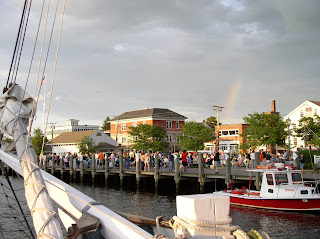
Sunset Cruise: July 13, 2009

The weather was great for this year's sunset cruise aboard the Argia, an authentic 81 foot replica of a 19th century schooner that sails out of Mystic, Connecticut. The cruise takes us into Fisher's Island Sound, just opposite St. Edmund's Retreat. There we hold a brief prayer service.
Deacon Derek, whose mom joined us for the event, did a great job leading us in prayer.
Enjoy the pictures!
(Click on images to enlarge.)
Thank God this guy wasn't really driving the boat!

(Don't worry, Mt. St. Mary's faculty, it's the Deacon's MOTHER!)


Sunday, July 05, 2009

What Would Our Founding Fathers Say?

(Fourteenth Sunday of the Year (B): This homily was given on July 5, 2009 at St. Pius X Church, Westerly, R.I., by Fr. Raymond Suriani. Read Ezekiel 2: 2-5; 2 Corinthians 12: 7-10; Mark 6: 1-6.) 


[For the audio version of this homily, click here: Fourteenth Sunday 2009

What would our Founding Fathers say? 

If they could be resurrected to this life for a brief period of time, and could survey the current state of affairs in the country they helped to establish, what do you think their reaction would be?  

Unfortunately, we can’t know the answer to that question with absolute certainty. We can’t know, beyond a shadow of a doubt, exactly what they would say in the face of contemporary American culture. But we can certainly venture a guess!—based on the things they DID say and write more than 200 years ago. 

For example: 

Here’s a great quote from John Adams, the second President of the United States: “Our Constitution was made only for a moral and religious people. It is wholly inadequate to the government of any other.” 

Based on that remark, I think President Adams would say to us, “The Constitution is failing you right now in the United States, because you’ve allowed yourselves to become another kind of people. To a great extent, your culture is no longer moral or religious.” 

Here’s one from Benjamin Rush, one of the signers of the Declaration of Independence: “[T]he only foundation for a useful education in a republic is to be laid in religion. Without this there can be no virtue, and without virtue there can be no liberty, and liberty is the object and life of all republican governments. Without religion, I believe that learning does real mischief to the morals and principles of mankind.”

I think Mr. Rush would say to us today, “Have you noticed that there’s a lot of ‘mischief’ in your society right now—mischief which is often sanctioned and promoted by some of your most highly-educated, anti-religious citizens? That’s not a coincidence.” 

Here’s one from John Jay, the first Chief Justice of the United States Supreme Court: “The Bible is the best of all books, for it is the word of God and teaches us the way to be happy in this world and in the next. Continue therefore to read it and to regulate your life by its precepts.”

Can you imagine what Chief Justice Jay would say about the current attempt to remove all references to God from the public life of our country? He’d probably say, “That’s the biggest mistake you could possibly make, America.” 

And finally there are these two from George Washington (you all know who he was): “Religion and morality are the essential pillars of civil society”; and “It is impossible to rightly govern a nation without God and the Bible.” 

In 2009, George would probably say, “Two hundred years ago I told you it was impossible to govern properly without reference to God and the Scriptures, but you obviously didn’t believe me. Good luck trying to do it another way.”

I think all these Founding Fathers would highly approve of the 3 Scripture readings that God has given us on this Independence Day weekend. They would find them most appropriate, given the current state of affairs in our nation. For example, you could very easily make the case that the United States right now is on the verge of a kind of internal collapse—just like the Kingdom of Judah was on the verge of collapse for its infidelity at the time of Ezekiel, the prophet. As we heard in today’s first reading, they were “a rebellious house.”

And when you think of all the prophetic people that God has sent to us Americans in recent decades, calling us to reform, calling us to turn away from materialism and hedonism and all the manifestations of the culture of death—people like Pope John Paul II, Pope Benedict XVI, Mother Teresa of Calcutta, and a host of lesser voices; when you think of all these prophetic souls and how they have been—and still are—ridiculed in popular culture and in our nation’s universities, you can’t help but think of the way Jesus was treated by the people of his own hometown of Nazareth 2,000 years ago. As we heard in today’s gospel reading, “they took offense at him.” They tuned him out and refused to believe his message because they thought he was too “ordinary.”

But notice there were consequences to their disbelief. Mark tells us that because of their lack of faith, Jesus was not able to do for the people of his hometown what he wanted to do for them! The evangelist wrote, “So he was not able to perform any mighty deed there, apart from curing a few sick people by laying hands on them. He was amazed at their lack of faith.”

The people of Nazareth couldn’t have it both ways, and neither can we as citizens of this great nation. If we want God’s blessings in abundance—blessings like peace and justice— then we need to take him and his word seriously. It’s that simple. Chief Justice John Jay understood that truth 200 years ago, as did most of our other Founding Fathers. 

We need to re-learn it in our generation. 

Thankfully, God does promise us sufficient grace in today’s second reading to deal with whatever will come in the future for our country. We can take some consolation in this: the Lord will be there to help those who are faithful to him no matter what happens. His words to St. Paul in this text from 2 Corinthians 12 are also spoken to us as individuals: “My grace is sufficient for you, for power is made perfect in weakness.” 

In the meantime, if we truly love our country, we should pray every day for the conversion of more of our citizens. (That’s because good Christians—at least in my view—make the best citizens.) We should also work for positive change in our nation as best we can by promoting virtue and actively opposing vice. And we should resolve in future elections to support only those men and women who actually believe in the principles our Founding Fathers believed in—starting with the right to life, enshrined in the Declaration of Independence.

I will close my homily now with a prayer for our nation that I found recently online. As I pray these words out loud, I invite you to join me in praying them in your heart:

God our Father, Giver of life, we entrust the United States of America to your loving care. You are the rock upon which this nation was founded. You alone are the true source of our cherished rights to life, liberty and the pursuit of happiness. Reclaim this land for your glory, and dwell among your people. Send your Spirit to touch the hearts of our nation’s leaders. Open their minds to the great worth of human life and the responsibilities that accompany human freedom. Remind your people that true happiness is rooted in seeking and doing your will. Through the intercession of Mary Immaculate, Patroness of our land, grant us the courage to reject the culture of death. Lead us into a new era of life. We ask all this through Christ our Lord. Amen.