Sunday, July 01, 2012

What to Say—and What Not to Say—In the Aftermath of a Tragic Death


(Thirteenth Sunday of the Year (B): This homily was given on July 1, 2012 at St. Pius X Church, Westerly, R.I., by Fr. Raymond Suriani.  Read Wisdom 1: 13-15; 2: 23-24; Mark 5: 21-43.)

[For the audio version of this homily, click here: Thirteenth Sunday 2012]


What do you say to the family of a 45-year-old man who died in a tragic car accident a few days earlier and left behind a young son?

I faced that difficult situation just a couple of weeks ago, after Jon Alberghini from our parish died in a head-on collision on Old Hopkinton Road.

Hopefully you’ll never have to address an issue like this publicly in a memorial service or at a funeral Mass, as I had to the other day during Jon’s funeral Liturgy.  But in all likelihood you will have to deal with it in private—for example, in one-on-one conversations with relatives and friends of people who died suddenly and unexpectedly—people like Jon, or like the daughter of Jairus in today’s gospel story.

So, what exactly do you say?  What should you say?

Well, sometimes it can be good and appropriate for us to say nothing—or very little.  Sometimes our presence with a grieving person says all that needs to be said.  Actions do, very often, speak louder than words.  Much louder.  When I was a young priest (many moons ago!), I remember an old pastor saying to me, “When tragedies strike, people will not always remember what you said to them, but they will remember that you were there.”

And I can verify that by my own experience.  On the night my father died back in 1971, my friend, Frank, came over to spend the night at my house.  I have no recollection of anything he said to me that evening.

But I do remember that he was there!  He was a friend who was there when I needed him the most.

Now when we do open our mouths to speak to a grieving person, one thing we should always avoid saying is, “I understand exactly what you’re going through”—because we don’t!

Dealing with the death of a relative or friend is a very “individual” thing; no two people handle it in exactly the same way.

Your experience of dealing with death may be similar to mine, but it will never be the same in every way. 

At times I may be moved to say to a grieving person—for example, to a young man who’s lost his father at a young age (as I did)—“I think I can understand a little of what you’re experiencing right now.”

But that’s as far as I’ll go with it.  To say anything more would be presumptuous—and wrong!

Although it can be helpful to try to imagine what the other person is experiencing: to put yourself in their place, so to speak—not so that you can offer them some pompous or sanctimonious words of advice, but rather so that you’ll have a deeper compassion for them in their suffering.

My mother taught me that one, many years ago.

But compassion alone is not sufficient.  If we really want to help others in their pain of loss, we need to have the right ideas in our heads about death!  That’s crucial!  In other words, we need to know the truth that the Church teaches concerning our eternal destiny.  We need to know this truth about death and what comes afterward, so that we can help grieving souls embrace it, because it’s only by embracing this truth that they’ll find hope—real hope—in the midst of their pain. 

Which is where today’s first reading comes into the picture.  When someone dies suddenly and tragically—like Jon Alberghini—I will often suggest to the family that they choose this particular text from the Book of Wisdom to be the first reading of the funeral Mass.  I’ll do that because there can be a tendency to blame God in these situations, as if God were the author of death.  And obviously, if people blame God for the death of a loved one, they’ll turn away from him in their grief—which is exactly the opposite of what they should do and what they need to do if they want hope.

Listen to this passage again:

God did not make death,

nor does he rejoice in the destruction of the living.

For he fashioned all things that they might have being;

and the creatures of the world are wholesome,

and there is not a destructive drug among them,

nor any domain of the netherworld on earth,

for justice is undying.

For God formed man to be imperishable;

the image of his own nature he made him.

But by the envy of the devil, death entered the world.

I love this passage because it makes clear, first of all, that God is not the dealer of death; rather, as we say in the Nicene Creed every Sunday, he’s “the Lord and giver of life”!  God gives life, not death.  Death came into the world “by the envy of the devil,” as the text says.  So he’s the one we should blame, not the Lord!

And “envy” is the perfect way to describe his attitude.  Envy, remember, is worse than jealousy.  The jealous person experiences resentment at the success or achievement of another individual.  But the envious person goes one step further by trying to hurt or destroy the other person in their success or achievement.

Once Satan fell and lost his place in heaven, his attitude became, “Yes, I know I’m going to hell for all eternity, but I’m not going alone!  I’m going to take as many angels and human beings with me as I can.  I’m going to destroy as many of them as possible.”

That’s envy—at its absolute worst!  And it was out of this diabolical envy that Satan tempted our first parents, Adam and Eve, in the Garden of Eden.

And we all know the rest of that story.  The temptation led to sin—the original sin—and this sin is what opened the door to sickness and death.

But God did not abandon us!  Because he loves us, and because—as this passage says—he formed us “to be imperishable,” he sent his Son into the world to restore what Satan had taken away. 

And, in the process, God gave us something even greater, namely, eternal life!  As it says in the Catechism, “The victory that Christ won over sin has given us greater blessings than those which sin had taken from us: ‘where sin increased, grace abounded all the more’ (Romans 5: 20).”  (CCC 420)

So yes, we still physically die; but if we’re united to Jesus by faith, and die in the state of grace, we receive something much greater afterward.  As St. Paul put it, “Eye has not seen, ear has not heard, nor has it entered into the mind of man, what God has prepared for those who love him.”

That’s the Good News of Christianity!

If we can help those who have experienced a tragic death to understand and embrace these core ideas of our faith, they will have hope.  Their pain will not go away—nor should it, since their pain is a sign of their love for the deceased person (remember, even Jesus wept when his friend Lazarus died); but they will have strength and hope in the midst of their pain and sadness.  They won’t blame the Lord for the tragic death of their relative or friend; rather, they will look to God in the confident hope that he has given their relative or friend the greatest possible gift: a perfect life that will never end.

Hopefully this homily has given you at least a few insights on what to say (and what not to say) when someone dies tragically.  Which brings me to my final word of advice: Remember to pray!  Prayer needs to be the foundation of whatever we do as Catholics.  So always remember to pray before you speak to any suffering person.  Ask the Lord to guide you in your speech (or in your silence), so that you will be his instrument of comfort, of hope and of peace.

Sunday, June 24, 2012

An Open Letter to Fr. Frank Francese on the Occasion of His Ordination to the Priesthood


(This homily was given on June 24, 2012—the Solemnity of the Birth of St. John the Baptist—by Fr. Raymond Suriani.)

[For the audio version of this homily, click here: Frank Francese First Mass Homily]


Preaching this weekend at St. Pius has presented me with a unique and extremely difficult challenge: to somehow bring together three different themes.  The first relates to the feast we’re celebrating in the Church in honor of St. John the Baptist; the second concerns the “Fortnight for Freedom”; and the third, of course, concerns the ordination of one of our parishioners, Frank Francese, to the priesthood.

What’s a preacher to do?

Well, I prayed about it for several days, and what I was prompted to do was write a letter—an open letter—to Fr. Frank on the occasion of his ordination.

My homily today, therefore, will consist of this letter, which I will now read to you.  (Normally I don’t read my homilies word for word, but since letters are meant to be read, today’s homily will be an exception to the rule.)

And even though it’s written to our newly ordained priest, most of what’s here applies to everyone—which is why it’s an open letter and not a private letter.


So here it is:


Dear Fr. Frank,

It is both significant and providential that you were ordained this weekend, when the Church universal celebrates the feast of the birth of St. John the Baptist, and as the Catholic Church here in the United States continues its observance of what our bishops are calling a “Fortnight for Freedom”.  These are to be 14 days of prayer, study, catechesis and action with a singular and urgent purpose: to inspire Catholics in the United States to stand up for and defend the right to religious freedom—not only for themselves, but for all Americans. 

Religious freedom is foundational to the political and social life of this country.  This is clear from the fact that it’s the very first freedom mentioned in the first amendment to our Constitution.  But it’s a freedom that we’re in grave danger of losing in the very near future, ironically because of the oppressive actions of our president and other civil leaders, all of whom have taken a sacred oath to protect and defend the Constitution in its totality.

It was not a coincidence that this Fortnight began on June 21st.  That happens to be the vigil of the feast day of Saints Thomas More and John Fisher: two courageous men of God who defended religious freedom in England in the mid-16th century, against a power-hungry king named Henry VIII.

John Fisher was a devoted bishop; Thomas More was a brilliant lawyer and the Lord Chancellor of England.  The very fact that they share the same feast day reminds us that the duty to defend religious liberty and the dignity of the human person is a duty that is shared by both the clergy and the laity.

It’s not just “the priest’s job”!  You, Fr. Frank, must make that clear to the people you serve in your parish, since it’s the laity who are primarily responsible (according to the teaching of the Second Vatican Council) for bringing the Gospel message into the marketplace that we call “the world.” 

You must form your people in the truth, and empower them through the sacraments, so that they can go forth and assume their rightful place at the forefront of this most important battle.

Before he was martyred for his faith, Thomas More reportedly uttered the famous words, “I die the king’s good servant—but God’s first.”  In that one line he shows us that there is no necessary contradiction between being a good Christian and a good citizen.  Thomas More was both in 16th century England.

Similarly, our first president, George Washington, knew that it was possible (and desirable) for Americans to be deeply religious and deeply patriotic at the same time.  In fact, he maintained that religion and morality are “indispensable supports” of our political prosperity.  Our second president, John Adams, obviously held the same view of these matters, as indicated by his famous statement, “Our Constitution was made only for a moral and religious people.  It is wholly inadequate to the government of any other.”

Our Founding Fathers—like John the Baptist, Thomas More and John Fisher before them—realized that good religion helps to form good and virtuous people, and good and virtuous people make the best citizens.

This truth, unfortunately, is no longer understood and embraced by many in our contemporary, American society—and that includes many of those currently in power in our civil government.

This has resulted in a blatant disregard for the freedom and conscience rights of Catholics and other loyal American citizens who identify themselves as “religious”.  The attempt by the Department of Health and Human Services to force religious institutions to pay (directly or indirectly) for abortions and for other services which they deem immoral is but one recent example of the phenomenon.

John the Baptist would not be silent in the face of such a moral outrage (King Herod would certainly attest to that fact), and neither must you be silent, Fr. Frank!  You are ordained to “speak the truth in love,” as St. Paul reminded you in Ephesians 4: 15.  His words to the young priest Timothy are also appropriate here: “I charge you to preach the word, to stay with this task whether convenient or inconvenient—correcting, reproving, appealing—constantly teaching and never losing patience.”

This will not be easy!  You may have to suffer greatly for your faithfulness to your priestly mandate.  And as More, Fisher and the Baptist remind us, martyrdom is not completely out of the question when one lives in a country whose leaders and laws are no longer rooted in and informed by the precepts of the natural law.

This is why you must be a man of prayer and the sacraments, always drawing your strength from the Lord and his mighty power (to quote yet another text of St. Paul).

On that note, I give you these practical words of advice:

  1. Make the Mass the center of your spiritual life.
  2. Pray for at least an hour a day, every day—preferably in the presence of the Blessed Sacrament. 
  3. Go to Confession regularly.  
  4. Immerse yourself in God’s word in Sacred Scripture. 
  5. Stay close to Mary, our Blessed Mother. 

And, in the process, make sure that your deeds witness to the truth of your words.  As we all know, some priests in recent decades have lived lives that have contradicted the words they preached from their pulpits, and we—clergy and laity alike—have suffered for their evil deeds.  And, of course, our enemies have sought to use this tragic and scandalous situation to their advantage, by attempting to discredit the entire Gospel message by discrediting the sinful messengers who delivered it.

Archbishop Fulton Sheen used to say that there’s only one argument left to convince the world of the truth we preach and teach, and that argument is holiness: our holiness as Catholics; your holiness, Fr. Frank, as an ordained priest of Jesus Christ.

And that’s why your greatest role model (indeed, our greatest role model) in this cultural battle to secure religious freedom in our nation has got to be Blessed John Paul II. 

John Paul II, in his holiness and in his prayerfulness, knew how to deal effectively with the civil leaders of his day who actively and consistently persecuted the Church and violated human rights.

His prayers from heaven can now help us to do the same in our present circumstances.

Thirty years ago, most people in the free world would not have believed that the scourge of Soviet Bloc communism could be eliminated without a major armed conflict, and perhaps even a nuclear war.

But it happened! 

And Pope John Paul II was a key player—many would say the key player—in this relatively peaceful collapse of a corrupt system of government: a system that was rooted both in atheism and in a denial of the dignity of the human person.  In June of 1979, John Paul visited his native land of Poland for the first time as Holy Father, and he immediately ignited what many historians have called “a revolution of conscience”. 

For the very first time an international figure publicly confronted the leaders of a communist regime—and lived to talk about it!

This inspired the oppressed Polish people—and countless others in Soviet Bloc countries—to pray, and to protest, and to work together peacefully for change.

And, ten years later, the Berlin Wall came down.

So there’s always hope!—even now, in the good, old U.S. of A.

But the current attacks on religious freedom in our country will not stop if we do not pray, and protest, and work peacefully together for change—like the citizens of Poland and Eastern Europe did three decades ago in their battle against communism.

You must also do your part, Fr. Frank, as a priest of Jesus Christ: by your holiness, by your teaching, by your sacramental ministry, and by your personal priestly witness.

Yes, it’s a challenging time to be a Catholic; yes, it’s a challenging time to be a priest.

But it’s also a great time to be both!  Because as a Catholic priest in 2012 you not only have the opportunity to help souls achieve eternal salvation; you can also help to secure religious liberty for all American citizens in our generation—and in generations to come.

So go forth, Fr. Frank; and, as Blessed John Paul II would say, “Be not afraid!”

Many of us—hopefully most of us—will stand with you!

Ad multos annos!

Sunday, June 10, 2012

Our Heavenly Father's ‘Dinner Rules’


(Corpus Christi 2012 (B):  This homily was given on June 10, 2012 at St. Pius X Church, Westerly, R.I. by Fr. Raymond Suriani.  Read 1 Corinthians 10: 16-1.)


[For the audio version of this homily, click here: Corpus Christi 2012]


"Be on time for supper." 

"When I call you for dinner, stop playing ball with your friends and come home immediately."

"Sit up straight in your chair."

"Don't put your water glass too close to the edge of the table; if you do, you might knock it onto the floor."

"Finish everything on your plate or no dessert."

"You do not leave the table until I or your mother give you permission to leave."

Those, my brothers and sisters, were some of my earthly father's "dinner rules."  They were never written down anywhere, but they were verbally promulgated quite often.  And whenever they were violated by yours' truly or his little sister (as happened on more than one occasion), an appropriate punishment was assigned and administered—immediately!  And, sadly, there was no “court of appeals” in the Suriani household at the time.  In matters such as these, my father was the Chief Justice of the Supreme Court—like it or not.

This morning I'd like to review with you some other dinner rules: the ones given to us by our Father in heaven.  They're given in reference to the meal his Son died to give us, the Holy Eucharist.  And they're given through his Son's mouthpiece on earth, the Church.  I decided to deal with this issue in today's homily for two reasons: first of all, because it's Corpus Christi Sunday; and, secondly, because many of our heavenly Father's children seem to be unclear about some of his dinner rules, even though these are written down for us in Scripture, in Canon Law, and in various other documents.

So here they are . . . (This, by the way, is not an exhaustive list.  These are just some of the more important ones.)

Rule # 1: When we come into the presence of the Blessed Sacrament, we should always genuflect (unless we are physically unable to do so!).  As it says in the document Eucharistiae Sacramentum: "Genuflection on one knee is prescribed before the Blessed Sacrament whether it be reserved in the tabernacle or exposed for public adoration."  We should also genuflect whenever we pass in front of the tabernacle or monstrance.  This is a sign of our recognition that we are in the presence of the King of kings and the Lord of lords. 

Do you genuflect before you enter your pew for Sunday Mass?

Rule # 2: Under ordinary circumstances, Protestants cannot receive the Eucharist in a Catholic Church.  And the corollary here is also true: Catholics cannot receive in a Protestant church—and that includes Christ Episcopal Church down the street!  (I mention Christ Episcopal because I've heard stories over the years about some of our parishioners receiving at funerals and weddings there!) 

Why these restrictions?  Is the Church being mean-spirited?  No, the Church is simply asking us to be honest.  In 1 Corinthians 10: 17, St. Paul says, "Because the loaf of bread is one, we, though many, are one body, for we all partake of the one loaf."  When we share Eucharist with others we are making a public statement that we are one in faith with them.  That's what Paul is telling us in this text.  But, unfortunately, we are not one in faith with our Protestant brothers and sisters.  Yes, we share some elements of belief in common, that's true; but not enough such that we can come together and partake of "the one loaf."

We’re working toward that unity—and hopefully someday it will be attained.  But we’re not there yet.  And we need to be honest about that.

Rule # 3: As we are told in Canon 919 of the Code of Canon Law: If we want to receive the Eucharist, we must fast for one solid hour from all food and drink (except water and medication).  That includes gum, by the way.  Obviously, if you are sick or unable to fast for a medical reason, then this rule does not apply to you.

Although not chewing gum at Mass does still apply! 

Rule # 4: Under ordinary circumstances, if we have committed a mortal sin we must not receive Communion until we have gone to Confession.  At the risk of offending some, I will now get specific, because when I make a statement like this in a homily, invariably some people will ask me later on: "But Fr. Ray, what sins would fit into that category?"  Well, here are some of the more common ones (I base this on my 26 years of hearing Confessions): missing Mass on a Sunday or Holy Day without good reason; deep hatred for another person (remember St. John in his first letter equates hatred with murder); adultery, fornication, masturbation, homosexual activity, artificial contraception, sterilization—and procedures like IVF. 

And, of course, if a person is involved in an invalid marriage, he or she must not receive until after the marriage is validated.  Now if that is your situation, please do not despair or get angry; simply make plans to see a priest or deacon, to discuss what needs to be done to straighten the matter out.

We deal with these situations all the time.

"Fr. Ray, these are very radical ideas."  No, they're not.  In fact, almost all of them can be found on the inside front cover of your missalette!  There you will find the official guidelines for receiving Communion given to us by the Catholic bishops of our country.  And please notice what they say about those who are unable to receive the Eucharist for one reason or another.  This is important, and can be a source of some consolation.  They say, "All who are not receiving Holy Communion are encouraged to express in their hearts a prayerful desire for unity with the Lord Jesus and with one another."  In other words, they are encouraged to ask Jesus into their hearts so they can have a "spiritual communion" with him.  They cannot receive him eucharistically, but they can (if they choose) receive the Lord in another way.  Here at St. Pius I also encourage those not receiving Communion to come up to me or Deacon Fran with their arms crossed over their chest in order to receive a blessing.  (But please keep in mind, this last one is a local dinner rule.  This type of blessing is not mandated by the Church, so it's not offered everywhere.)

Finally, a few quick rules on receiving:

Number 1: When we approach the altar, we should do so with reverence.  I suggest folding your hands in this fashion; unless, of course, you have a bambino in your arms.  In that case, please do not fold your hands and drop your baby!  (Common sense should be your guide here.)

Number 2: Our focus should be on Whom we are about to receive, not on those who have already received—or on anything else, for that matter.  We should be preparing for our encounter with the King of kings and the Lord of Lords!

Number 3: Before we receive we are supposed to make an act of reverence.  Here’s what it says in the General Instruction to the Roman Missal: “When receiving Holy Communion, the communicant bows his or her head before the Sacrament as a gesture of reverence and receives the Body of the Lord from the minister.”  (GIRM 160) 

Number 4: If we choose to receive in the hand, we should make a "throne" for the Lord in this fashion.  (No “coin slots” or “slides” or picking the host out of the priest’s hand, please!)

Number 5: When the priest or deacon or extraordinary minister says, "The Body of Christ," we are to say, "Amen."  Not "Thank you."  Not "Have a nice day, Father"—or anything else.  Nor are we to do an impression of a mime, and say nothing at all! 

Number 6: If we receive in the hand, we are to take one step to the side and consume the Eucharist right there at the foot of the sanctuary.  We are not to take Communion back to our pew—or home to our sick relatives.  If someone at home is unable to come to Mass and wants to receive, let us know.  We have extraordinary ministers who take Communion to the sick of our parish every Sunday.

Now I must admit something to you: In all honesty, when I was growing up, I didn't always like my earthly father's dinner rules.  At times they seemed unreasonable, arbitrary, and just plain unfair!  But looking back on it now, I realize he was right.  My father wanted our suppers to be pleasant experiences for everyone in the family.  And his rules—when they were actually followed by my sister and me—helped to make it happen.  Our heavenly Father's dinner rules are given for a similar purpose: so that the Eucharistic banquet which we celebrate here will be a spiritually profitable experience for everybody involved.  May our observance of these rules help to make that happen.
Every Sunday.

Sunday, June 03, 2012

What It Means to Say, “I Believe in the Blessed Trinity.”


(Trinity Sunday 2012: This homily was given on June 3, 2012 at St. Pius X Church, Westerly, R.I., by Fr. Raymond Suriani.  Read Matthew 28: 16-20.)

[For the audio version of this homily, click here: Trinity Sunday 2012]


What does it mean to say, “I believe in the Blessed Trinity”?

That seems like an appropriate question to explore on Trinity Sunday.  It’s also a very important question to explore because, as the Catechism says, the mystery of the Most Holy Trinity is “the central mystery of Christian faith and life.”  (CCC, 234)

In a certain sense, everything we believe as Catholic Christians about salvation rests on the reality—that is to say, the existence—of the Blessed Trinity.  Think about it.  If there is no Trinity, then Jesus Christ was certainly not the divine and only-begotten Son of God.  He couldn’t have been.  He was simply an ordinary, finite human person, whose actions were ordinary and finite—like yours and mine.  That means he was incapable of making atonement for the sins of the entire human race—because only a divine Person whose actions have infinite value could atone for the sins of the whole world and bring forgiveness and salvation to the entire human race.

So the bottom line is this: If the Blessed Trinity does not exist, you are, as St. Paul would say, “still in your sins.”

And there’s no hope of heaven—for you or anyone else!

Obviously, then, there’s a lot at stake here.

And what are some of the other concrete implications of this foundational teaching of the Church?  What else does it mean to say, “I believe in the Blessed Trinity?”

Well, on the negative side, to say you believe in the Blessed Trinity means that you’re not a Jehovah’s Witness or a Mormon.

People in those groups do not believe in the Trinity, even though they say they believe in the Father, Son and Holy Spirit.  As Fr. William Saunders wrote in an article on EWTN’s website: “The Jehovah's Witnesses say that Jesus is God's Son, but is inferior to God. They condemn the Trinity as pagan idolatry and accordingly deny Christ's divinity.  Russell [the founder of the Jehovah’s Witnesses] even claimed that the Trinity was the idea of Satan. Ironically, however, when they baptize, they use the formula, ‘...In the name of the Father, and of the Son and of the Holy Spirit.’”

Interestingly enough, so do the Mormons, but they also reject the traditional Christian teaching that there are three divine Persons in the one, eternal God.

Confusing?—yes, but true nonetheless!

To say you believe in the Blessed Trinity also means that you believe that God, in himself, is a kind of “family”—a family of divine Persons united by an intense and perfect bond of love.

And, if you believe that, of course, you will probably pray a lot to the three Persons of the Trinity for your family here on earth: You will pray that the perfect love present between the Father, Son and Holy Spirit will be reflected more perfectly in the love that your family members have for one another.

To say you believe in the Blessed Trinity also means that your view of marriage and sexuality will be different from the views of those who don’t believe in the Trinity. 

This is something Pope John Paul II taught us in his lessons on the Theology of the Body.  He said that, in a very real way, the self-giving of a husband and wife to one another in marriage (and especially in the marital act) mirrors the divine self-giving that is present in the inner life of the Blessed Trinity.

So much for the idea that the Church thinks that sex is dirty!  No, it’s the Hugh Hefners of the world who teach us that.  The Church teaches that within marriage sex is actually holy, because it reflects this total self-giving that we find between the Persons of the Trinity.

I should also mention here that this gives us an insight as to why so-called “gay marriage” is impossible.  The love between the Father and the Son in the Blessed Trinity is a fruitful love: from their intense and perfect love the Holy Spirit proceeds.

So if marriage here on earth is supposed to reflect the inner life of the Blessed Trinity, it obviously must have the natural potential to be fruitful.  But only a man and a woman have that potential by nature.  Two men don’t, and neither do two women.

And that’s true even if the man and woman are elderly.  Even in their 90s, a married man and woman still have the natural potential to have children, even though, practically speaking, a pregnancy won’t occur without a miracle.

To say you believe in the Blessed Trinity also means that you believe everything you say in the Nicene Creed every Sunday, and in the Apostles’ Creed when you say your Rosary.

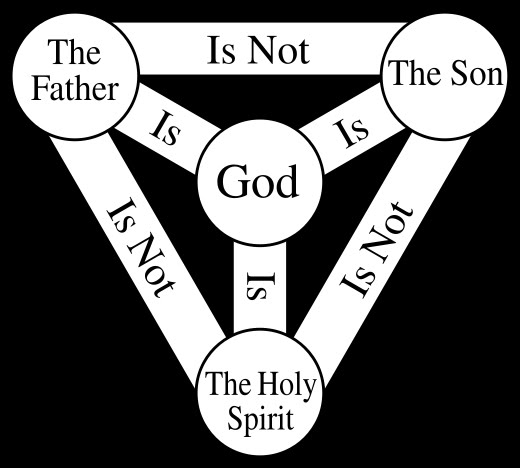
To say you believe in the Blessed Trinity means you believe that there is only one God, but that he exists in three distinct divine Persons.  Thus, the Father is God and the Son is God and the Holy Spirit is God; however, the Father is not the Son, and the Son is not the Spirit, and the Father is not the Spirit.  They are not three gods; rather, they are one God, because they have one and the same divine nature.

Confusing?  Perhaps—but true nonetheless! 

Which brings me to my final point: We can know that God exists from reason alone.  We don’t need a special revelation to come to that conclusion.  We can figure out that God exists just from looking at the world around us.

But we would never know about the inner life of God—that he is one and three at the same time—unless he had revealed that truth to us in Sacred Scripture and in the teachings of Jesus Christ and his Church.

And so, to say you believe in the Blessed Trinity means that you accept the fact that you will never fully understand this mystery with your finite and imperfect human mind!

To coin a phrase from my former theology professor at PC, Fr. Giles Dimock, when it comes to the Blessed Trinity, we can know many things, but eventually we have to “fold the wings of our intellect, and bow to the mystery.”

May God—the Triune God (Father, Son and Holy Spirit)—give each of us the grace to do that.