Sunday, March 24, 2013

Holy Week: A Time of Change


(Palm Sunday 2013 (C): This homily was given on March 24, 2013 at St. Pius X Church, Westerly, R.I., by Fr. Raymond Suriani.  Read Isaiah 50:4-7; Philippians 2:6-11; Luke 22:14-23:56.)

[For the audio version of this homily, click here: Palm Sunday 2013]


The very first Holy Week was a period of time when changes took place in many different people: some of the changes were good, and some of them were not-so-good.

One of the most disturbing changes in the not-so-good category took place in the hearts and souls of certain residents of Jerusalem.  Think about it: Some of the same men and women who were hailing Jesus as the Messiah on Palm Sunday were screaming for his blood on Good Friday!

The changing tide of public opinion: one day you’re the greatest person on earth, the next day you’re “public enemy number one”!

(That’s why we should always try to please God, and not human beings.)

And how about the change in Judas Iscariot?  That was another terrible tragedy of Holy Week!  This man went from being a close, intimate friend of the divine Son of God, to the worst traitor in the history of the world!

Peter also changed for the worse during these few short days, when he denied three times that he even knew our Lord—although, thankfully, he eventually changed back through repentance.

Actually all the apostles changed for the worse, since, as St. Mark tells us, they all abandoned Jesus as soon as our Lord was arrested in the garden of Gethsemane. 

But, thanks be to God, many other people changed for the better during the first Holy Week!  The “Good Thief,” for example (who is only mentioned in Luke’s version of the passion), changed radically as he hung next to Jesus on Good Friday.  He made a 180 degree turnaround in his heart, and so he joined our Lord that day in Paradise!

(All of which shows that deathbed conversions can and do happen!  Yes—they might be rare, but they certainly are possible.)

The Roman centurion who stood at the foot of the cross changed for the better: he became a believer—a man of faith—after he saw the way that Jesus died.

Joseph of Arimathea changed in a positive way by becoming an openly-committed disciple of Jesus when he came forth to claim our Lord’s body for burial, having been a secret disciple of Jesus before that.

Even our Blessed Mother underwent a kind of change from Palm Sunday to Good Friday.  She went from being “the rejoicing Mother” of the Messiah as she watched her Son enter Jerusalem in triumph, to “the sorrowful Mother” of the Savior as she stood at the foot of his cross—in the process becoming a role model for us as we struggle to deal with our daily crosses.

I share these thoughts with you today in this brief homily to encourage us all to make some time for the Lord during this Holy Week—because if we do that we also have the opportunity to change for the better!  This Holy Week is like the first one in that sense: it provides an opportunity for us to change our lives in a positive way!  But for that to happen, we need to enter into it by our active participation. 

Let me conclude now by sharing with you this week’s schedule of events here at St. Pius.  When you go home, I highly encourage you to put at least some of these events on your calendars:

On Monday, Tuesday and Wednesday we will have morning Mass as usual at 7am; on Thursday, Friday and Saturday we will have morning prayer at the normal Mass times.  The Easter Triduum begins with the Mass of the Lord’s Supper on Thursday evening at 7pm, followed by adoration of the Blessed Sacrament in the church hall until 11pm (a time for us to remember the Lord’s agony in the Garden of Gethsemane).  On Friday we will have Stations of the Cross twice: once outside at noon (specifically designed for young people and families); then, at 3pm, here in church.  The celebration of the Lord’s Passion will take place on Friday evening at 7; and the first Mass of Easter—the glorious celebration of the Easter Vigil—will be held at 7:30pm on Saturday night. 

Please note: there will be no 5pm Mass next Saturday!  The normal time for our vigil Mass is changed (as hopefully we will be—for the better!—when this Holy Week is over).

Sunday, March 17, 2013

The Well-Formed Conscience of Jean Valjean


Hugh Jackman as Jean Valjean in Les Miserables
 

(Fifth Sunday of Lent (C): This homily was given on March 17, 2013 at St. Pius X Church, Westerly, R.I. by Fr. Raymond Suriani.  Read John 8: 1-11.)
 
[For the audio version of this homily, click here: Fifth Sunday of Lent 2013]


After you see a movie that’s based on a novel, certain people will say to you, “Oh yes, the movie was good—I saw it, too—but you should definitely read the book, because the book is much better.”

And they’re usually right.

Well, based on what I’ve said in past homilies, you know that I absolutely love Les Miserables, the movie that came out this past Christmas, and which won 3 Oscars a few weeks ago.

I love it almost as much as I love the musical version of the story, which I have been blessed to see several times.

Both the film and the musical, of course, are based on Victor Hugo’s novel of the same name.

Well, given the fact that in so many cases the book is truly better than the movie, I made the decision recently to get Les Mis for my Kindle, and read it.

And I did.  Well, at least I’ve begun to read it.  I’ve only begun because Les Miserables is not what you would call, “a quick read”!  It’s almost 1,500 pages long, small print!  Victor Hugo was obviously a man who LOVED to write—and write—and write!  What most people would say in 10 words, he says in 110 words—or more! 

All I can say is: Be glad you have me for your pastor and not him!  If he were your priest, you’d be here for 3 hours every Sunday (or Saturday night as the case might be).

Now don’t get me wrong, I’m really enjoying the book so far (I’m about a third of the way through it).  I just wish some of his descriptions of things were shorter and a little less detailed.

With one very notable exception, namely, his account of Jean Valjean’s battle with his conscience—the battle he had at a crucial point after his conversion.  True to form, Hugo goes on describing the details of this battle—this internal struggle of Jean Valjean—for many, many pages.

But in this case I’m glad he did that, because the length of the description makes a very important point.  The point is that sometimes doing the right thing isn’t easy—it’s a big struggle—even if your conscience is guiding you properly and helping you to see what you should do!

Let me now give you a brief synopsis of what Valjean was struggling with . . .

At the beginning of the story (which takes place in early 19th century France) Valjean is paroled, after spending 19 years in prison for stealing a loaf of bread.  He comes out of prison a bitter man, but he experiences a genuine conversion with the help of a saintly bishop.  He then breaks his parole, assumes a new identity, and begins to live a very holy, charitable life.  He moves to another town where nobody knows him; he starts a business that provides jobs for many needy people there, and is incredibly generous with his money.  In fact, he’s eventually elected mayor because people love him so much.

But then one day he hears that a man called “Jean Valjean”—an ex-convict who broke his parole many years earlier—is set to go on trial in a distant city the following day.  Valjean, of course, knows that this is a case of mistaken identity: he knows that he’s the guy they’re looking for!  This man they have in custody is innocent.

But what should he do?  If he goes to the court and reveals himself as the real Jean Valjean, he’ll probably be arrested immediately and sent back to the prison and the galleys for the rest of his life; but if he doesn’t go, he allows an innocent man to be convicted and to suffer punishment unjustly (life imprisonment and perhaps even death!).  In the musical, his struggle is summed up in one line.  Valjean sings, “If I speak, I am condemned; [but] if I stay silent, I am damned.”

Well, in the novel (as I said a few moments ago), the struggle is recounted over many, many pages—because it was so deep and so intense.  Valjean, for example, paces the floor the whole night before the trial, going back and forth in his thoughts.  Deep down inside knows that he should go and reveal himself to the court, but another voice in his head is giving him all the reasons he should just stay at home and let the other guy get condemned: The people of this town need me; they count on my leadership.  Children look up to me; how can I let them down?  I’m providing for the families of the people who work in my factory; I’m helping poor souls who will probably die without all my charitable gifts.

Even after he decides to go to the courthouse, he struggles; even as he enters the courtroom itself, the battle rages on inside him.

Conscience.  Jean Valjean had formed his well—that’s why he knew the right thing to do.  But a conscience needs to be followed after it’s formed!

And that’s where it can be very difficult.  Just ask Jean Valjean.

I usually don’t give the enemies of Jesus in the gospels credit for much, but I will say something positive today about the scribes and the Pharisees that we hear about in this story of the woman caught in the act of adultery.  These men had not formed their consciences as well as Jean Valjean had formed his, but they had formed them well enough to recognize some of their sins—perhaps because Jesus was writing them in the sand!  Now they could have ignored what their consciences were telling them and gone on to stone the woman anyway!  But, to their credit, they all did listen to their consciences—and to the challenge of Jesus—and they walked away.

I mention this today because many Catholics and other Christians in the modern world use “conscience” as an excuse for doing what they feel like doing or what they want to do, rather than seeing it as a summons to do what they ought to do!

“Well, my conscience tells me that _________ is ok.”  (Fill in that blank with any sin: lying, cheating on my taxes, artificial contraception, abortion, being unfaithful to my spouse, holding a grudge, etc.)

“My conscience tells me it’s okay to do this.”

Well, it’s important for us to remember that our consciences will guide us properly ONLY if they are formed properly!  Jean Valjean’s conscience was telling him, “It’s wrong for you to allow that innocent man to go to jail for the rest of his life!” because Valjean had formed his conscience based on the Ten Commandments and the Golden Rule.  His conscience was guiding him properly because it was formed properly.

The consciences of the scribes and Pharisees were telling them, “You’d better not throw any stones at this woman,” because their consciences had been formed properly to the point where these men were at least able to recognize some of their own sins.  They were blind, unfortunately, to their hatred of Jesus (which was also a sin—a very big sin!), but they were clear about some other things.

I encourage you to read, in the near future, what the Catechism teaches about conscience, since there’s so much confusion and misinformation out there concerning this subject.  It all begins in paragraph 1776 (which should be easy to remember, since that’s year the Declaration of Independence was signed!).

I’ll quote just a few of the more important lines to you here: 

  • From paragraph 1778: Conscience is a judgment of reason whereby the human person recognizes the moral quality of a concrete act that he is going to perform, is in the process of performing, or has already completed.
  • From paragraph 1799: Faced with a moral choice, conscience can make either a right judgment in accordance with reason and the divine law or, on the contrary, an erroneous judgment that departs from them.
  • From paragraph 1783: Conscience must be informed and moral judgment enlightened. A well-formed conscience is upright and truthful.
  • From paragraph 1785:  In the formation of conscience the Word of God is the light for our path, we must assimilate it in faith and prayer and put it into practice.  (That basically means that we are to form our consciences based on objective truth, and not on our personal feelings or ideas!)
  • And, finally, from paragraph 1784: The education of the conscience is a lifelong task.

Let me conclude now with a final word on Jean Valjean, since I left him a few moments ago in the midst of a terrible conscience crisis.

He did the right thing!  That’s the bottom line: He did the right thing.

He went to the courthouse and revealed himself to be the real Jean Valjean.

“But, Fr. Ray, he obviously didn’t stay in jail, because the story continued—for about 1,200 more pages!  So what happened?”

That, I won’t tell you.  To find out, you’ll have to read the book.   

Or, if you don’t have either the time or the desire to read a 1,500 page novel, just go to see the Oscar winning movie starring Hugh Jackman and Anne Hathaway.  That will only take 2 ½ hours of your time, but, I guarantee you, it will be 2 ½ hours well-spent!


Friday, March 15, 2013

An Evening With Frank Kelly


On March 15, we were blessed to have Frank Kelly with us for a special Mass, talk, and healing service.  Frank shared his story of how the Lord spared his life when he was electrocuted at work, and how God called him to his present ministry of healing and evangelization.
Click on the links below to listen to Frank's witness talk, and to the homily I gave at the Mass that evening.

Fr. Ray's Homily

Frank Kelly's Witness

Sunday, March 10, 2013

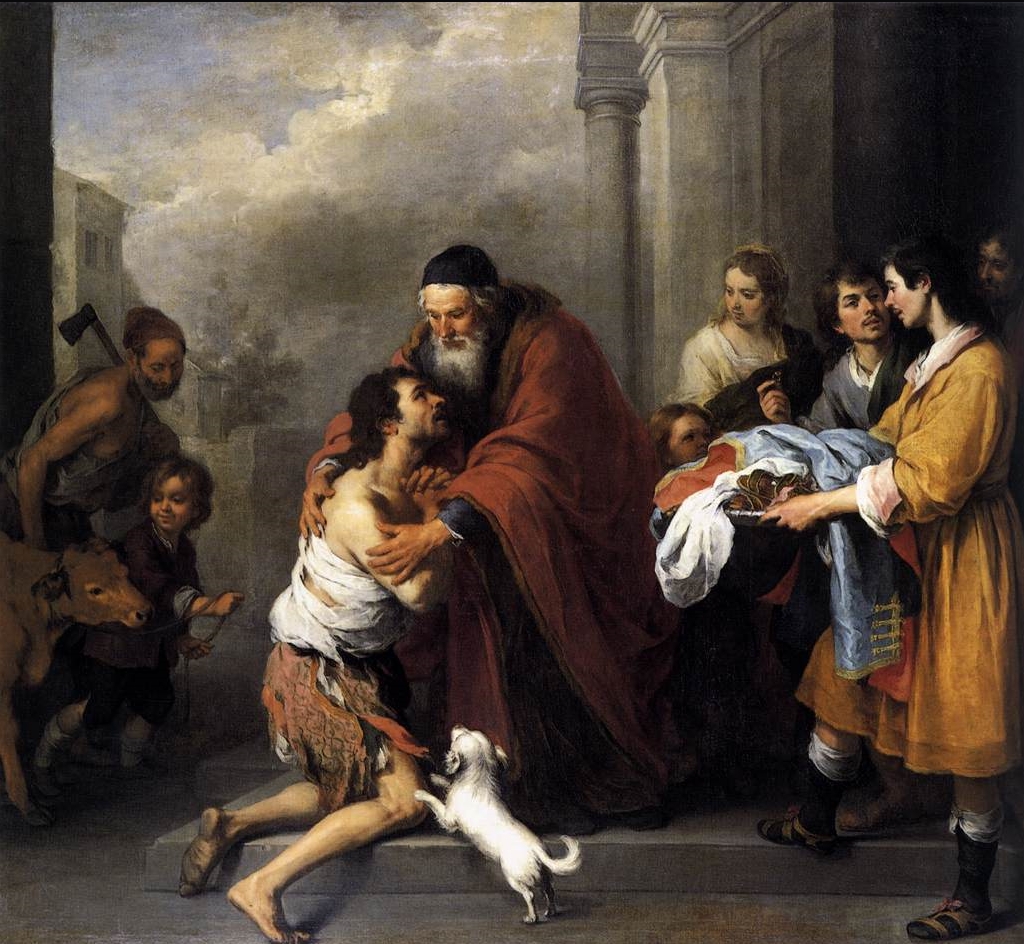
What ‘Experience’ Taught the Prodigal Son


(Fourth Sunday of Lent (C):  This homily was given on March 10, 2013 at St. Pius X Church, Westerly, R.I., by Fr. Raymond Suriani.  Read Luke 15: 1-3, 11-32.)

[For the audio version of this homily, click here: Fourth Sunday of Lent 2013]


They say that experience is the best teacher.

Well that’s certainly the way it was for the prodigal son.  This boy learned a lot—about himself, about his family, and about life in general—through the experiences that he had between the time he left home with his inheritance and the time he returned home without it.

He learned, first of all, that no sins are unforgivable!  And that was a crucial lesson for him to learn, because I don’t think he believed his sins could be forgiven!  Now that’s somewhat understandable, because in leaving as he did, he knew that he had decisively cut himself off from his father and from his family.  Notice that the passage says that this boy took “all his belongings.”  He took them all because he never intended to go back!  And that’s why his dad said he was “dead”.  He wasn’t physically dead; he was spiritually dead! 

In theological terms, he had committed a mortal sin.  (Actually, from the way the story is told, it seems that he had committed a number of mortal sins!)  Remember what a mortal sin is: it’s one that cuts us off from God the Father and from the sanctifying grace that comes to us through our spiritual family, the Church.  Or, as the Catechism puts it: “Mortal sin destroys charity in the heart of man by a grave violation of God’s law; it turns man away from God, who is his ultimate end and his beatitude, by preferring an inferior good to him.”  (CCC, 1855)

The prodigal son didn’t think he could be forgiven for his many mortal sins; he just hoped that he could be “tolerated” by his father for what he had done.  But he soon learned that his father’s mercy was greater than all the evils he had committed.

Hopefully we learn that very same lesson every time we go to Confession.  On that note, when was the last time you went?  Thankfully, there’s still time to go during this season of Lent.

It’s important to mention Confession in this context because another thing the prodigal son learned by experience was that reconciliation with his dad wasn’t automatic.  It wasn’t something that was “just  going to happen”.  After breaking his relationship with his father, he realized that he needed to do something to repair the damage: specifically, he needed to go to his dad and verbally acknowledge his guilt—which he did: “Father, I have sinned against heaven and against you.”

Well that’s precisely what we do in Confession, is it not?  We go to our heavenly Father, through the priest, and verbally acknowledge the evil we have done, as well as the good we have failed to do (in other words, our sins of commission and our sins of omission).

In the experience of going to his dad and verbalizing his guilt, the prodigal son learned yet another lesson: He learned that his father was looking for a reason not to give him what he deserved!  This boy knew he deserved punishment—severe punishment; he knew that he deserved to be permanently excluded from the family (“Father, I have sinned against heaven and against you.  I no longer deserve to be called your son.”)

The father, thankfully, ignored that last remark and welcomed his wayward son home. 

By showing sincere repentance and acknowledging his sin, the prodigal son gave his dad a reason—a great reason—not to give him what he deserved.

Which, as we heard a few moments ago, greatly upset his older brother!  I find it very interesting, the father in this story (who obviously represents God the Father) looks for a reason not to give his prodigal son what he deserves, whereas it’s pretty clear that the older boy wants to see his prodigal brother get exactly what he deserves (and perhaps a little extra as well!).

That fact says a lot about the difference between God and us.  I think most people, in similar circumstances, would feel like that older son felt.

In addition to all the lessons he learned about repentance, mercy and forgiveness, the prodigal son also learned a few other things.  For example, he learned, through his experience, that sometimes suffering can be a blessing in disguise!  Think about it: if he had not spent all that time with Porky Pig and his friends in that filthy pig sty, he probably would never have re-established his relationship with his dad!  In all likelihood, the two would have remained disconnected for the rest of their lives.  But his suffering woke him up, and motivated him to go back to his father in a spirit of sincere repentance.  And that was a great blessing.

I encourage you to try to think of that the next time you experience a terrible suffering in your life: it can be the source of some very special graces.

THE PRODIGAL SON also learned to be grateful.  He learned to be grateful for the many blessings he had enjoyed in his father’s house—blessings that he had obviously taken for granted earlier in his life.  In fact, that’s one of the reasons he left his dad in the first place: he didn’t realize he had it so good!

SO OBVIOUSLY HE ALSO LEARNED THE IMPORTANCE OF FAMILY; HE LEARNED THAT PEOPLE ARE MORE IMPORTANT THAN THINGS; HE LEARNED THAT HE COULD NOW CHANGE HIS LIFE AND BECOME A HOLY AND MERCIFUL PERSON (he learned that from the great example of his dad); AND HE LEARNED ABOUT THE DESTRUCTIVE POWER OF PRIDE AND ANGER (he received that lesson, unfortunately, from the very bad example of his older brother).

Of course, it’s one thing to learn all this from your past experience; it’s quite another thing to apply it in the present moment for the sake of your future!  I pray today that the prodigal son did both: that he learned these lessons by his experience of sin and repentance, and that he then allowed these lessons to have a positive impact on him for the rest of his life.

If he did, then he certainly became a saint—and in that he becomes a great example for all of us to try to follow.