Sunday, August 15, 2021

Mary's Continuous 'Yes' to God: What it Meant for her, and What it Means for us

St. Peter at the Pearly Gates


(Solemnity of the Assumption: This homily was given on August 15, 2021 at St. Pius X Church, Westerly, R.I., by Fr. Raymond Suriani.  Read Revelation 11:19a; 12:1-10; Psalm 45:10-16; 1 Corinthians 15:20-27; Luke 1: 39-56.)

[For the audio version of this homily, click here: Assumption 2021]


One day a priest died, and he found himself standing in line at the pearly gates of Heaven.  Ahead of him was a man dressed in sunglasses, a leather jacket and worn-out jeans.  St. Peter, who was sitting at his check-in desk, said to the man, "Sir, please tell me your name.  If it's on my list, then I can let you into the Kingdom of Heaven."  The man replied, "I'm Joe Cohen, a taxi driver from New York City."  St. Peter looked at his list, and he smiled.  He said, "Congratulations, Joe.  You made it.  Now take this silken robe and golden staff and enter the kingdom prepared for you from the foundation of the world."

Next in line was the priest.  Without even being asked, he said, "I'm Fr. Joseph Snow, and I was pastor of St. Mary's Church for the last forty-three years."  St. Peter once again looked over his list, and once again he smiled.  He said, "Congratulations, Father.  You also have made it.  Now take this cotton robe and wooden staff and enter the kingdom prepared for you from the foundation of the world."

The priest said, "Hold on, St. Peter.  Wait just a minute.  That odd-looking man was a taxi driver, and he got a silken robe and a golden staff.  I was the pastor of one of the biggest parishes of the diocese—for 43 years! —and all you're giving me is a cotton robe and wooden staff.  How can that be?"

St. Peter responded, "Father, up here we judge people by results.  When you preached, people slept; but when that guy drove, people prayed!"

I tell that story this morning because today the Church focuses our attention on the "result" of the Blessed Mother's Yes to God, and on the ultimate fruit of that result.  Recall that when the Lord asked Mary at the Annunciation to be the mother of his Son, she responded, "Be it done unto me according to your Word."  The result of that Yes was ultimately the world's salvation: the offer of salvation to every human person, and the salvation of Mary herself.  Contrary to what some non-Catholics think we believe, the Blessed Mother did not save herself.  The Catholic Church has never taught that!  Mary was saved by the Passion, Death and Resurrection of her divine Son by being preserved from Original Sin from the first moment of her conception.  But without her Yes, the Savior would never have been born into the world to suffer, die and rise for her and for all of us.   

And because Mary's Yes to God was continuous throughout her life—such that she never committed a single sin—she's been given much more than a silken robe and a golden staff.  As we were told in today's first reading from Revelation 12, she's received a crown of twelve stars and been made the Queen of Heaven and earth!  That means she's already been given a full participation in the resurrected life of her Son.  And this is precisely what the Assumption of our Lady is all about. 

The Church teaches that when we die, our souls are separated from our bodies, and our souls go either to Heaven, Hell or Purgatory.  Only at the Final Judgment will our bodies be resurrected and reunited with our souls.  But for the Blessed Mother, the separation never occurred.  At the end of her earthly life, she was taken—soul and body—into the Lord's eternal Kingdom.  And so, her Assumption is, as the Catechism tells us, "a singular participation in her Son's Resurrection, and an anticipation of the resurrection of other Christians." (CCC, 966) That means, quite simply, that what's already happened to Mary will someday happen to us, if we are in the state of grace when we die.

That, of course, is a big and crucial "if."  Like Joe the wild taxi driver and Fr. Joe the boring priest, we will all face God's judgment at the end of our lives.  Consequently, to be ready for that event, we need to examine our consciences every day—not just once a year during the Easter season—and go to Confession as often as necessary.  In that way we will have a moral certainty that we are in the state of grace.  Because, even though we will never be as holy as Mary was, God still has much more for each of us than a silken robe and a golden staff.  He has a Kingdom: a glorious Kingdom, an eternal Kingdom, a Kingdom that his only begotten Son died to give us.  And so today, on this Solemnity of the Assumption, we should say, "Thank you, Mary, for saying Yes!'"

 

Sunday, August 08, 2021

The Holy Eucharist and Eternal Life


(Nineteenth Sunday of the Year (B): This homily was given on August 8, 2021 at St. Pius X Church and at St. Clare’s Church, Westerly, R.I., by Fr. Raymond Suriani.  Read 1 Kings 19:4-8; Psalm 34:2-9; Ephesians 4:30-5:2; John 6:41-51.) 

[For the audio version of this homily, click here: Nineteenth Sunday 2021]


We know what Jesus said, but what exactly did he mean?

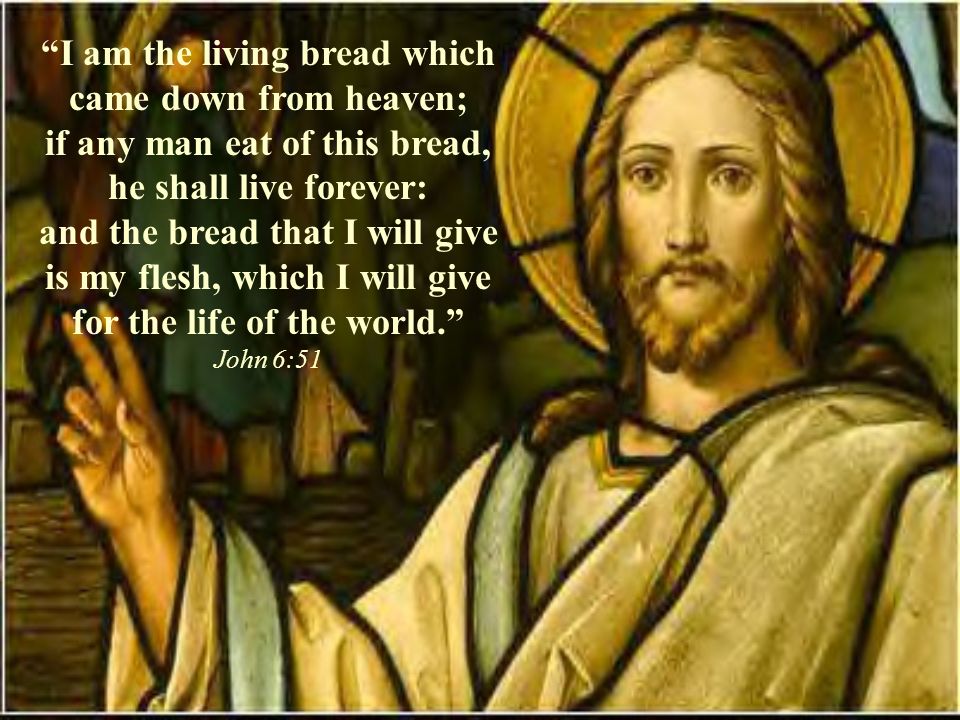
Here’s what he said: “I am the living bread that came down from heaven; whoever eats this bread will live forever; and the bread that I will give is my flesh for the life of the world.”

Jesus appears to be saying that whoever receives the Eucharist (even once) will definitely go to heaven—as if receiving Holy Communion guarantees a person’s eternal salvation.

But is that what he meant?

Well, to answer that question, we need to think of the natural food we eat every day, because there’s always a parallel between the natural and the spiritual.  (God has designed the universe in this way: by means of the natural world he gives us insights into spiritual realities like the Eucharist.)

Consider, now, the natural food we eat at breakfast, lunch and dinner.  For that food to nourish us in the way that it’s supposed to, certain conditions have to be met.  First of all, the quality of the food has got to be good: spoiled food can make you seriously ill.  (Some of us, I’m sure, know this from our own experience!  We’ve been in the emergency room at some point in the past because we ate something that we shouldn’t have.)

But that’s only half the story.  Even if a plate of fresh, well-prepared, gourmet food is set before us at a given meal, it will still not have its proper physical effect in us if our personal health is bad.

This is also easy to illustrate: Most of us have had the very unpleasant experience of getting sick and then losing our desire to eat.  All of a sudden, our appetite is gone.  The foods we normally love become distasteful to us.  And if we try to “force them down,” so to speak, our body may actually reject them.  (I don’t think I need to go into greater detail on that point.  You know exactly what I mean!)

So, on the natural level, if food is to nourish us, IT must be good and OUR PHYSICAL HEALTH must be good.

Well, not surprisingly, a parallel truth applies on the spiritual level.  Simply put, if we are to receive spiritual nourishment from something, the spiritual food we are consuming must be good, AND the health of our soul must be good.

And this is the key point, which will help us to make sense of what Jesus says in this text concerning the connection between the Eucharist and eternal life.

Now with respect to the Blessed Sacrament, there can be no question about the quality of this spiritual food: it’s the best—the very best—since it’s the Lord’s own Body and Blood.

But if our soul is not in good health—that is to say, if we have committed a mortal sin, and not brought it to Confession yet (a sin like missing Sunday Mass, or an act of sexual impurity)—then the Eucharist will not have the spiritual effect that it’s supposed to have in us!  When we’re physically sick, our bodies can’t process good, natural food properly; and when we’re spiritually ill, our souls can’t “process” the Eucharist properly.

This is why St. Paul told the Corinthians to examine themselves before they came to Communion.  He wanted them to receive strength, comfort, peace—and eternal life!—from the Body and Blood of the Lord.  But he knew that that wouldn’t happen, if the Corinthians were in the state of mortal sin.  They would commit a sacrilege instead.

So obviously there’s an implicit condition present in those words of Jesus we heard a few moments ago: “I am the living bread that came down from heaven; whoever eats this bread will live forever; and the bread that I will give is my flesh for the life of the world.”

The condition?  The condition is that we be IN THE STATE OF GRACE!  Eternal life comes by receiving the Eucharist, yes—but only when a person receives it worthily.

Personally, I can’t think of a better reason to go to Confession often!

Sunday, August 01, 2021

Recognizing the Presence of Jesus Christ in the Holy Eucharist


(Eighteenth Sunday of the Year (B): This homily was given on August 1, 2021 at St. Pius X Church, Westerly, R.I., by Fr. Raymond Suriani.  Read Exodus 16:2-16; Psalm 78: 3-4, 23-25, 54; Ephesians 4:17-24; John 6:24-35.)

[For the audio version of this homily, click here: Eighteenth Sunday 2021]


When I was first ordained back in 1985, I remember a man coming up to me one day after a Sunday Mass, carrying his two children.  He had one in each arm.  The oldest was four years-old; the other was two.  The man said to me, “You know, Fr. Ray, when I came up to you to receive Communion today my four year-old son wanted to know if he could say ‘Hi’ to Jesus.  I told him, ‘No!’”  “Wow,” I said to him, “You mean that your son already understands that what I give out at Communion time is really the Body and Blood of Jesus Christ?”  I was impressed.  But the father replied, “Oh no, Fr. Ray, you don’t understand.  My son said that because he thinks that YOU look like Jesus!”

So much for my brilliant deductions.

Naturally it is extremely difficult for any child of four to recognize the Lord’s presence in the Blessed Sacrament.  But of course it’s also just as difficult for the rest of us.  Sadly, age does not necessarily increase the quality of our spiritual awareness and vision.  And spiritual vision is what we need in order to be aware of the fact that the Eucharist is not a symbol, but is truly the Body, Blood, Soul and Divinity of the Savior of the world.

In a sense you could say that we need to put on “spiritual glasses” if we want to be able to see Christ in the Blessed Sacrament.  But those glasses are not easily acquired. 

Maybe part of the difficulty we have in recognizing the Lord’s presence in this sacrament is that we don’t expect the Almighty, omniscient, eternal God to be present in such a small “package.”  As Mother Teresa once put it: “How much smaller could he have made himself than a little piece of bread—the Bread of Life?  How much more weak and helpless?”

The idea that God would give himself to human beings in this way can be difficult to grasp and understand.  But we’re not the only ones in history who have had this problem.  The crowd that Jesus faced in the sixth chapter of John’s Gospel (where today’s gospel reading is taken from) also faced this difficulty.

I find it interesting that the crowd back then had no trouble whatsoever accepting the miracle of the loaves.  That didn’t challenge their faith at all.  As we heard in last weekend’s gospel reading, after they ate the meal Jesus gave them they were so happy that were ready to carry our Lord off and make him their king!

It was only when Jesus began to instruct them on heavenly food (i.e., the Holy Eucharist) that the trouble began.  We see the conflict between our Lord and the crowd beginning to develop in this week’s reading.  But it gets even worse in the later verses of John 6.

Our Lord first of all said to the crowd, “I know why you want to see me again.  It’s because I fed you with earthly food.  It’s because I gave you all a good meal of bread and fish.  But now I want to tell you about another kind of food—another kind of bread—a ‘heavenly’ kind of bread.”

Of course, as happened so often in our Lord’s ministry, the crowd misunderstood him completely.  They thought he was going to give them a new kind of manna, akin to what the Hebrews got in the desert at the time of Moses (we heard about that in our first reading today)—except that this manna (this new manna) would never spoil.  Well, they thought that sounded like a great idea, so they said to our Lord, “Sir, give us this bread always!”

Jesus responded by setting them straight.  He said, in effect, “I’m not talking about manna like the kind Moses gave you; I’m talking about myself.  I am the Bread of Life!”

That’s when the trouble began.  This was a truth that this particular crowd could not accept.  That’s clear from what we’re told in the rest of John 6.  Finally it came to the point where some of them said, “This sort of talk is hard to endure!  How can anyone take it seriously?”  And many walked away from Jesus at that point—even some who had previously been his loyal followers.

There’s an old hymn that has the line in it: “Look beyond the bread you eat; see your Savior and your Lord.”  That’s the challenge of faith that faces each and every one of us.  It’s the challenge to recognize the presence of Jesus Christ—Body and Blood, Soul and Divinity—in the Holy Eucharist.

And it is possible to do.  Whenever I brought my grandmother Communion in the latter years of her life, she would always say to me before I left, “Thank you, Raymond, for bringing God to me.”  Not “Thank you, Raymond, for bringing ‘the bread’ to me”; not “Thank you, Raymond, for bringing ‘the host’ to me”; rather “Thank you, Raymond, for bringing GOD to me.” 

My grandmother was a woman who had a simple—but a very deep—faith. My grandmother was a woman whose spiritual vision was 20/20, especially when it came to the Holy Eucharist.

Let us pray today at this Mass, that our spiritual vision will be the same.

Sunday, July 25, 2021

Soggy Fish Sandwiches?


(Seventeenth Sunday of the Year (B): This homily was given on July 25, 2021 at St. Pius X Church, Westerly, R.I., by Fr. Raymond Suriani.  Read 2 Kings 4: 42-44; Psalm 145: 10-18; Ephesians 4: 1-6; John 6: 1-15.)

[For the audio version of this homily, click here: Seventeenth Sunday 2021]


The late Fr. Benedict Groeschel used to refer to it—disdainfully—as “the soggy fish sandwich theory.”  This, he said, is the way some modern Scripture scholars try to explain away the miracle story we just heard from John 6: the multiplication of the loaves and fishes.  Since these professors do not believe that miracles are possible, they theorize that many of the people who came to hear Jesus that day already had bread and fish with them! And once they saw the disciples passing out the five loaves and the two fish that they had been given (in other words, once they saw the disciples sharing their food in this way), they decided to do the same thing.  And so the miracle was NOT that the loaves and fishes literally multiplied; the miracle was that the people who had bread and fish SHARED with the people who didn’t have any!  Everyone then ate to their heart’s content—and, amazingly, they still had some soggy fish sandwiches left over.  Fr. Groeschel usually ended his reflection on this subject by saying, “It makes me sick.”  Needless to say, he did not buy into the soggy fish sandwich theory!

The problem here is that even though these Scripture scholars claim to be believers, they have a preconceived prejudice against the supernatural.  In other words, if they can’t explain it in purely human terms, then (according to them) it could not have possibly happened.  And there are many people in the world today who have this attitude.  All of them, by the way, could take a lesson from one of the greatest scientists who ever lived—Albert Einstein.  One day many years ago Einstein was visited by a young priest from New York named Charles McTague.  They sat down in his office, and Einstein proceeded to tell Fr. McTague that he wanted to talk to him about (of all things) the Catholic doctrine of the Holy Eucharist.  It seems that Einstein was fascinated by the idea of a substance that you can’t see; a substance that has no shape or size or color.  (“A substance with no accidents,” as we say in theology.)  As many of us know, the Church teaches that at the consecration of the Mass the substance of the bread and wine becomes the substance of the Body and Blood of Jesus Christ, even though the accidents (in other words, the physical qualities) of the bread and wine remain.  Finally, at the end of the conversation, Einstein said to the priest, “Please send me any books in German that you can find that tell me about the Holy Eucharist.”  And that’s what Fr. McTague did.

Now what I find most interesting about this story is the fact that Einstein was open to the possibility of the supernatural.  He didn’t say, “My mind is the measure of all things, and if I can’t explain something using my scientific categories, then it doesn’t exist.”  His attitude was, “Maybe there’s something to it.  Maybe it’s true.  And if that’s the case, then I need to be open to this truth, even it’s beyond the categories of physical science.”

Perhaps Einstein would not have been surprised by the story that a parishioner once told me about an experience he had in Okinawa back in the 1940s, during the Second World War.  The parishioner said, “Two of my friends and I were walking on the beach in Okinawa one Sunday morning, and we came across a small, flat-bottomed boat; so we decided to take it for a ride.  Well, we had only been out for about five minutes, when a big storm hit.  We tried to paddle back to the shore but we couldn’t make it.  We thought for sure that we were going to die.  My friends were crying, but I was praying!  I prayed the Act of Contrition, the Our Father, and the Hail Mary.  We were tossed around in that storm for several hours.  Finally, at one point, I looked up, and I saw this large blue light near the boat.  My friends didn’t see it, but I did.  I had a strong sense that it was the Blessed Mother watching over us.  Then, all of a sudden, a boat appeared behind the light, and we were rescued. 

“Afterward, I spoke to the captain of the ship.  I said, ‘How did you find us in that horrible storm?’  The captain said, ‘Well, I spotted a strange, blue light off in the distance.  I decided to follow that light, and I ended up at your boat.’”

Was it the Blessed Mother?  Could it possibly have been the Blessed Mother?  Could it possibly have been a supernatural event?  If we believe in the “soggy fish sandwich theory” of the gospel story we just heard, then we will say, “No way; it’s impossible; it was just a stroke of good luck; it was just a coincidence.”  Personally, given the fact that I hate soggy fish sandwiches, I am of a different opinion.  I hope and pray that you are too.