Sunday, September 25, 2005

You Are What You Preach—To Yourself!


The Cast of "Laguna Beach."

(Twenty-sixth Sunday of the Year (A): This homily was given on September 25, 2005 at St. Pius X Church, Westerly, R.I. Read Matthew 21: 28-32.)

[For the audio version of this homily, click here: Twenty-sixth Sunday 2005]


What messages are you giving in your preaching?

That’s a question for me to answer, but it’s also a question for you to answer.

I am the preacher at this Mass (like it or not!), but I am not the only preacher in this church at the present moment.

The fact of the matter is, if you are old enough to think clearly and rationally, you are also a preacher—even if you don’t realize it.

The only difference between my preaching and your preaching is that most of the time your congregation is a lot smaller than mine is.

My congregation consists of all of you; your congregation usually consists of one person and one person only—yourself (unless, of course, you have moments when you get “preachy” with your friends: then your congregation also increases in size!).

Of course, there are times when I preach only to myself as well. Actually, I do that far more frequently than I preach to all of you. So please don’t complain if you only have to listen to me once a week! I have to listen to me as I preach to myself every day!

This phenomenon of “preaching to yourself” stands behind the events of today’s gospel parable from Matthew 21. Jesus here talks about two sons. The father asked each to go out and work in the family vineyard. The first said No, but ended up going; the second said Yes, but never went.

Why?

What is it that happened between their initial responses (yes or no), and their final decisions (to go or not to go)?

The answer is: “Each son preached a sermon to himself; and each son followed the preacher’s advice!”

Let me prove that to you.

The father said to the first son, “Go out and work in the vineyard today.”

The son said, “I will not,” and walked away.

That’s when his sermon to himself began. I went something like this: “You know, your father has been good to you. He loves you; he provides for your needs; he makes sacrifices for you every day. The least you can do is help him out in his vineyard. That’s not too much to ask. Besides, the fourth commandment says, ‘Honor your father and your mother.’ God would want you to go; he’d want you to obey. So do it!”

And he did. He went.

The father then said to the second son, “You go out and work in the vineyard today.”

This son said, “Yes, sir,”—and he would have been fine, if he hadn’t made the mistake of preaching a really bad sermon to himself as he was leaving his father’s presence!

His went something like this: “This father of yours always wants something—and it’s never enough! ‘Do this, do that’—all day, every day. Your friends are right: your father is always taking advantage of you. He’s unreasonable and he’s unfair! Well this time, you need to put your foot down. You’ve got other things to do; you don’t need this aggravation. Why don’t you go off with your friends and do something fun for a change? You deserve it!”

Such was his sermon.

Obviously preaching makes a difference—a big difference—especially when the preaching comes from yourself!

This means that it’s crucial for all of us preachers to get our sermon material from the right places! If we tend to follow the dictates of our own preaching (and we all do!), then we obviously need to utilize the right material to shape our personal sermons!

For example, the first son—although he initially said No—made the right decision in the end because the 4th commandment influenced the sermon he preached to himself. The commandment, in effect, was his sermon-source.

The second son, on the other hand, was influenced in his sermon by his own selfishness and laziness—and perhaps by his less-than-stellar friends—and in the end he made the wrong decision. His emotions—and perhaps the dictates of his friends—were his sermon-sources for the day.

So—from whence do you normally get your sermon material? In other words, what are your sources?

I urge you to reflect on that this morning.

Our primary source for our personal sermons should be God’s word, as found in the Scriptures and in the Catechism—and as preached in the Sunday homily by a faithful bishop, priest or deacon. Our friends, the books we read, the TV shows we watch, the songs we listen to, etc.: these can all be good secondary sources of sermon material if—and this is a big if—if they echo the truths found in God’s word!

If they don’t, then they must be rejected—or they will lead us to become like the disobedient son in that parable, who said he would go to work in the vineyard but never did.

Unfortunately, in today’s secular culture, there aren’t as many good, secondary sources of sermon material as there used to be. To figure that out, all you have to do is turn on the television set for awhile.

On that note . . . a couple of weeks ago, I asked the teens at prayer group on Thursday night the following questions: “In your opinion, what are the 3 most popular television shows among teenagers today?” and “What are the lessons teens are learning from watching these shows?”

I split them into two groups and sent them into separate rooms to discuss the questions. Both groups came back and listed “The O.C.” and “Laguna Beach” among the top 3 programs. That’s interesting because “Laguna Beach” is a “reality show” which is set in “the O.C.” (Orange County, California). In fact, the full title of the show is “Laguna Beach: The Real Orange County.”

For those who may not know what these shows are about, here’s how one writer from San Francisco, Lorraine Sanders, described “Laguna Beach” and connected it to the other program, “The O.C.”:

“On ‘Laguna Beach,’ eight perfectly coiffed, impossibly stylish high school students cruise through their hometown in expensive SUVs. Our occasional narrator, Lauren, a.k.a. ‘L.C.,’ and her friend Lo commiserate about tanned heartthrob Stephen, whose on-again, off-again girlfriend Kristen spends most of her time badmouthing L.C. and playing mind games with her male admirers.

“Our kids have beach bonfires, get their nails done, head to LA fashion shows and party as only 18-year-olds can when they hit Cabo San Lucas for spring break. All that’s lacking of ‘The O.C.’ is a tad more teen angst and screwed-up parents acting out for the cameras.”

The question I have for young viewers of these shows is this: If you allow the content of these programs to directly influence the sermons you preach to yourselves every day, what kind of messages will your sermons contain?

I dare say, the messages probably will not be: “Honor your father and mother; treat members of the opposite sex with respect; be honest; don’t be materialistic; and don’t abuse your body with alcohol or drugs!”

More than likely you’ll be preaching the opposite messages to yourselves.

Of course, to be fair, I could ask this same question of older viewers concerning “Sex In the City,” or “The Young And The Restless,” or almost any other program on daytime or primetime TV!

There’s an old saying that we’ve all heard before: You are what you eat. Well, here’s another saying that’s equally as true: You are what you preach—to yourself!

That was true of the two sons in this Gospel parable, and it’s true of you and of me.

Which brings me right back to the question I began with: What messages are you giving in your preaching?

Monday, September 12, 2005

A Glorious Day! St. Pius X Parish Celebrates Its 50th Anniversary!

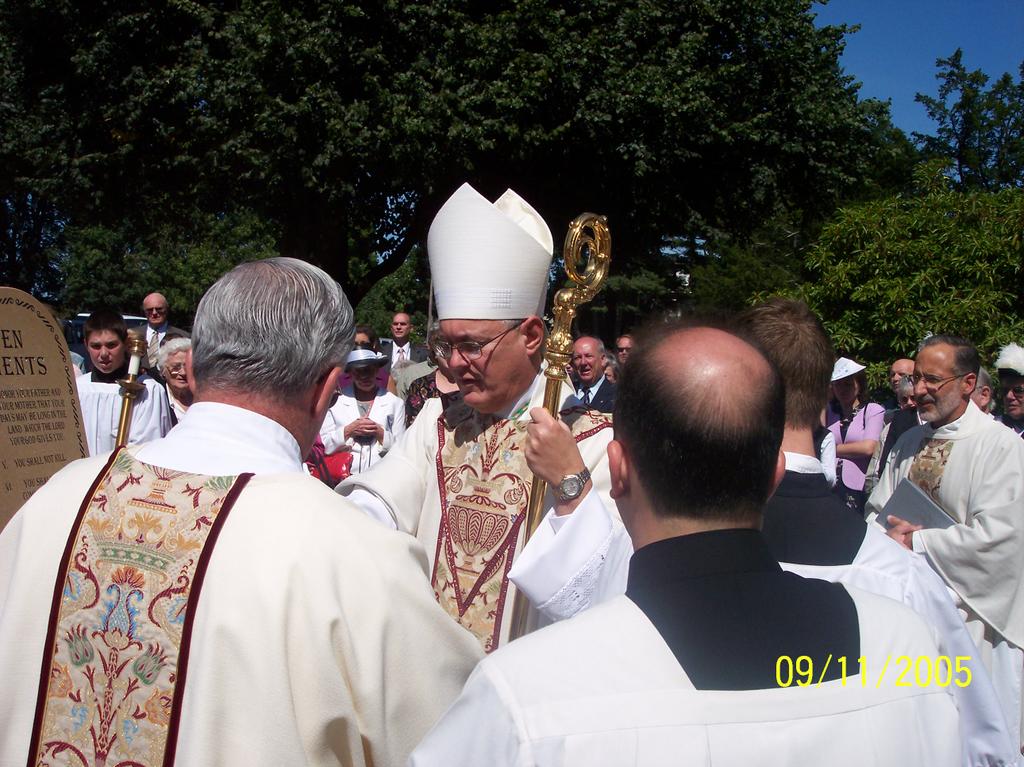
On Sunday, September 11, 2005, St. Pius X Parish celebrated its 50th anniversary in glorious fashion with a Mass at 11 am. Our new bishop, Thomas Tobin, was the main celebrant, and Fr. Jordan Mary Turano, O.P., was the homilist.

The Liturgy was beautiful; the music was magnificent; the homily was inspiring; the food at the dinner which followed at the Watch Hill Inn was excellent--and the weather was perfect!

Now for a little background on our parish:

It was established by the Most Rev. Russell J. McVinney, then the Bishop of Providence, on September 8, 1955. Here's how our local paper, the Westerly Sun, described it in its September 9, 1955 issue:

"Rev. Russell J. McVinney, D.D., Bishop of Providence, today announced the establishment of a new parish in Westerly to be known as St. Pius X to serve the needs of Catholics living in the fringe areas of Immaculate Conception Church in Westerly and St. Clare's Church, Misquamicut. . . .

"Rev. William J. Farrell, assistant pastor of St. Augustine's Church, Providence, is pastor of the new St. Pius X Parish. He is expected to assume his duties here within a few days.


"Division of the Church of the Immaculate Conception Parish had been contemplated for some time by Bishop McVinney and while the change may cause some inconveniences at the
beginning, it eventually will lead to greater spiritual and religious opportunities for Catholic parishioners in Westerly.

"The new parish will mean the assignment of more priests to Westerly and will ease the
heavy attendance at the Church of the Immaculate Conception which now conducts Masses in the upper and lower churches in order to accommodate all its parishioners.

"Rev. Irenee Duperry, S.M., pastor of the Church of the Immaculate Conception said this morning that even with the territorial division, his church will have a parish of approximately 1200 families and there will be several hundred in the area served by St. Pius X Church.

"Until the proper provisions are made, the parishioners in St. Pius X Parish will continue to attend Mass at their usual church."


Parishioners of St. Pius X met for Mass at Immaculate Conception until the new church on Elm St. was completed and consecrated by Bishop McVinney on December 1, 1957.

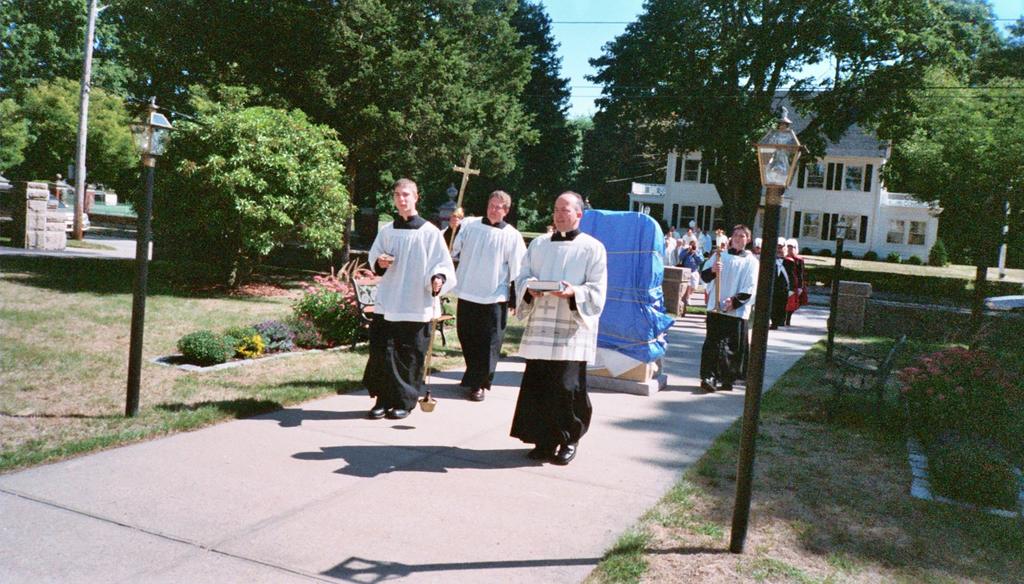
This year, we celebrated our anniversary in a number of ways. We had a Eucharistic procession on Corpus Christi Sunday, from Immaculate Conception to St. Pius--symbolizing the fact that 50 years ago the Eucharist in a certain sense "travelled" to Pius from our Mother Church on High St.

We plan to make this an annual event.

We also held a parish picnic. This, too, we plan on having every year in the future.

We held and art contest for our young people. The theme was, "What St. Pius X Parish means to me."

We sold commemorative items: hats, T-shirts and sweatshirts.

We brought the community together through a pasta and meatball dinner (which drew nearly 300 people!) and a fried dough breakfast. Through these two events, we raised enough money (with the help of the Knights of Columbus) to purchase a Ten Commandments monument--a permanent memorial to our first 50 years.

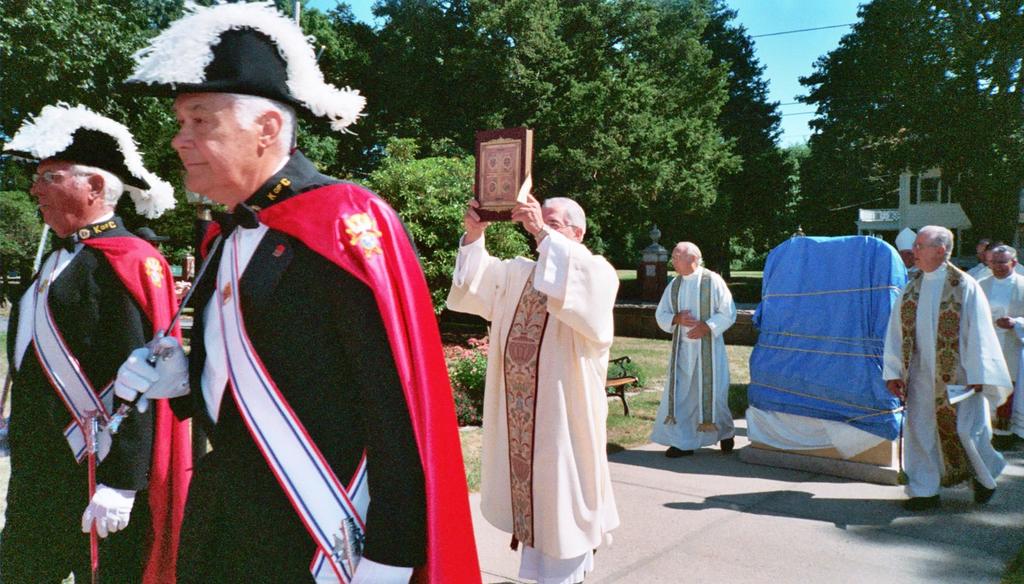
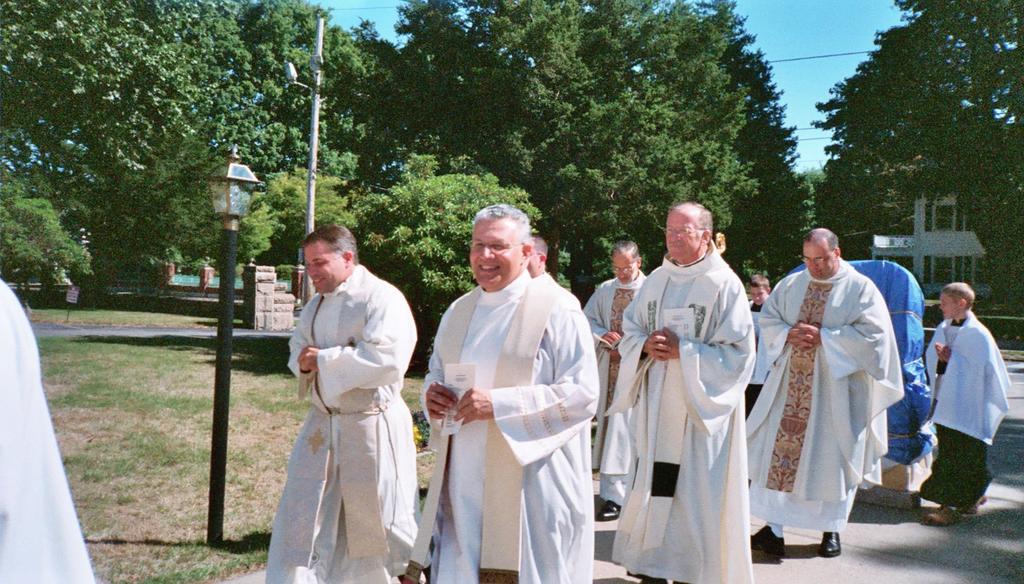
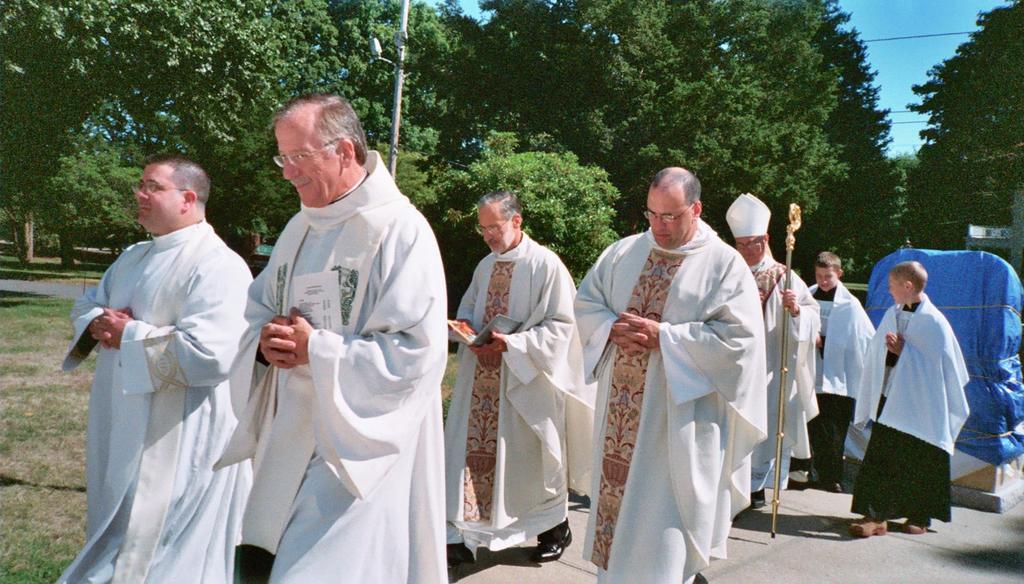
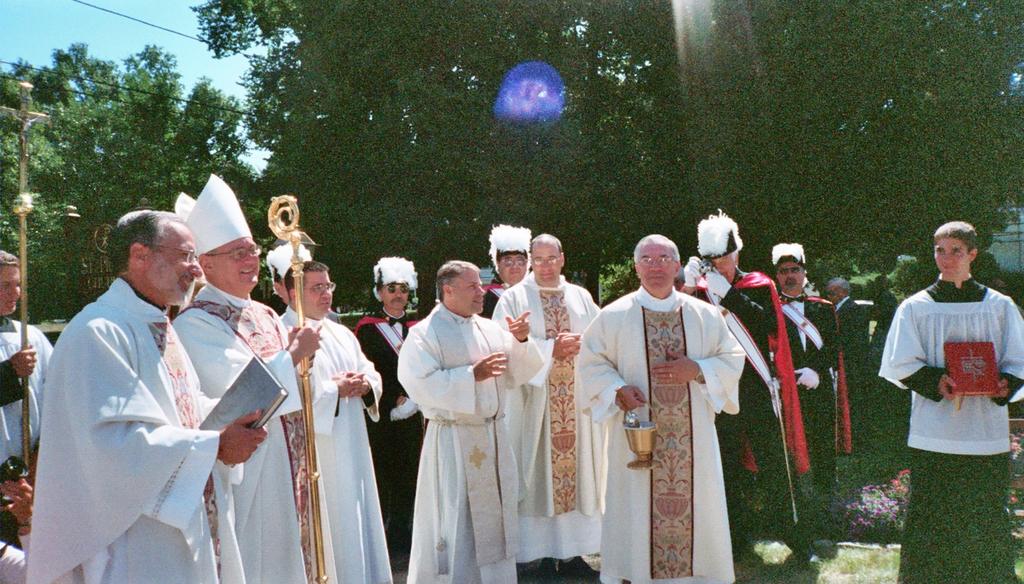
And then yesterday (September 11), the anniversary Mass was celebrated. Here are some pictures from the event:

The Entrance Procession.
(Click on pictures to enlarge.)


"The Mass is ended."
Time to bless the Ten Commandments Monument in front of the church.


Bishop Tobin blesses the monument.


Jerry Swerdlick, a 1st degree Knight, pretending to be a 4th degree.

Tuesday, August 30, 2005

How Deep Is Your Love?


The Brothers Gibb, alias the Bee Gees.

(Twenty-third Sunday of the Year (A): This homily was given at St. Pius X Church, Westerly, R.I. Read Romans 13: 8-10; Matthew 18: 15-20.)

[For the audio version of this homily, click here: Twenty-third Sunday 2005]


How deep is your love?

The Bee Gees turned that little question into a number 1 song back in the late 1970s, making millions of dollars in the process.

Today I’ll turn it into the theme of my Sunday homily and won’t make any money whatsoever—but hopefully the message I share will help all of us to become better disciples of Jesus Christ (which is really much more important in the long run).

How deep is your love?

Now in past generations the meaning of that question would have been crystal clear. But in an era of trashy soap operas, sleazy novels and “The Real World” of MTV—it definitely needs to be explained a little bit.

When I use the term “love” in this context, I’m talking about authentic, genuine love—not the counterfeit version that’s so prevalent in our culture at the present time.

Speaking of the counterfeit, last week I was listening to the radio, and I heard a man from California being interviewed on a talk show. This man claims to love his wife, but he wants to go out with another woman because “that’s how men are; they need that kind of experience from time to time.” And he expects his wife to show her love for him by respecting his “needs” and tolerating his behavior.

Now I’ll be honest with you, when I first heard this I thought for sure that the man was joking, but it soon became clear to me that he was dead serious! And the talk show host wasn’t startled in the least by the man’s remarks!

Please understand: when I ask, “How deep is your love?” that’s definitely not the type of love I’m talking about!

I’m talking about the “real deal,” which is best defined by the image on the back wall of our sanctuary: the cross of Jesus Christ!

“Greater love no one has,’ Jesus said, ‘than to lay down his life for his friends.”

I could begin by asking, “Is your love that deep?”—but since I don’t want to discourage anyone at the start I won’t.

To love in this Christ-like, Biblical sense is “to desire the good” for somebody else. Jesus died on the cross because he desired the “good”--namely, heaven--for each of us and for every human person created in his image and likeness.

At the beginning of today’s second reading from Romans 12, St. Paul says something very interesting. He says that we actually “owe” this type of love to other people.

And why is that? Why are we expected by God to show this love to others?

Because Jesus first showed it to us, that’s why! He showed it to us when he poured out his blood for our salvation.

Jesus thought that human beings were worth this type of radical, selfless, sacrificial love—and according to St. Paul if Jesus thought that about people, then so should we!

Back now to the issue I raised at the beginning of my homily: How deep is your love? How deep is it at the present moment?

Is it deep enough such that you would never consciously lead another person into sin? In the last verse of today’s second reading St. Paul says, “Love does no evil to the neighbor.” If I really love you it means that I would never consciously encourage you to damage your relationship with Almighty God or with others in any way! But think how often people today lead their so-called friends into sin. It happens all the time!—“C’mon, nobody will get hurt; nobody will know; you’ll have a good time.”

Think of how many marriages and families have been destroyed with that line! If someone tries to lead you into sin in this way in the near future, remember the message of this homily, and realize that that person doesn’t really love you—at least they don’t love you with the authentic love of Jesus Christ!

How deep is your love?

Is it deep enough such that you will tell your friends the truth when they do something wrong? This is certainly one of the messages of today’s Gospel passage from Matthew 18. Jesus is instructing his disciples here on how to love those who sin against them in some way. (I know the text doesn’t sound like it’s about love, but it is!) Jesus begins by saying, “If your brother sins against you, go and tell him his fault.” Most of us (and I definitely include myself here) would rather avoid confrontation in our interpersonal relationships. But if we really do love others, we need to pray for the grace to overcome that tendency to be silent. We need to pray for the grace to tell them the truth they need to hear about themselves, in a respectful way.

How deep is your love?

Is it deep enough, such that you will make every effort to share the truth of the Gospel with your friends and acquaintances (even if you don’t see them doing something seriously wrong)? Think about it . . . the greatest “good” we can desire for any other person is their eternal salvation. But sometimes that’s the last thing people are willing to talk about—even with those they claim to love deeply! That makes no sense does it?

And finally, Is your love deep enough, such that you will be willing to avoid someone’s company for a time, to make it clear to them that their unrepented sin is grossly unacceptable? This is another difficult one, and it should only be done as a last resort—as Jesus indicates in this Gospel. That’s what he means when he says that after you have made every other effort to deal with the sinner, you should “treat him as you would a Gentile or a tax collector.” Basically that means avoiding his company for a time—until he’s willing to take responsibility for his behavior.

Psychologists often refer to this approach as “tough love”. It’s very hard to do—especially with members of your immediate family (some of us know this by experience)—but at times it can be necessary, as Jesus indicates here.

How deep is your love?

If you’ve somehow managed to stay awake during this homily and have faced the issue honestly, you now realize why you need to come to Mass—at least every Sunday and holy day!

It’s because your love is not deep enough—and neither is mine! And so we come to Mass to receive the grace of God by listening to his message of love in Scripture, and by receiving the sacrament of his love, the Holy Eucharist, so that his real love within us will grow--and be more visibly evident when we leave here.

This means that all good Catholics—from the pope on down—will have to answer this simple question in the very same way.

If someone says to them, “How deep is your love?” they will respond with honesty and with faith by saying, “Not deep enough; but hopefully getting deeper--by the grace of God—each and every day and at each and every Mass.


Thursday, August 11, 2005

When It Comes To Your Catholic Faith, Do You Have A ‘Game Face’? And How Often Do You Have It On?


Tom Brady, Curt Schilling, Tiger Woods and Lance Armstrong with their "game faces" on.


(Twentieth Sunday of the Year (A): This homily was given on August 14, 2005 at St. Pius X Church, Westerly, R.I. Read Matthew 15: 21-28.)

[For the audio version of this homily, click here: Twentieth Sunday 2005]


It’s called “a game face”.

It’s the look that every great athlete has when he’s about to compete for a big prize in his chosen sport. Tom Brady has had it in 3 Super Bowls. Curt Schilling had it in game 6 of last year’s ALCS against the Yankees, and in game 2 of the World Series against the Cardinals. Tiger Woods has it in every major golf tournament. Lance Armstrong has had it in the last 7 Tour de France cycling races—and he’s won them all!

Having a game face is about having a certain appearance, a certain look in your eyes when you’re competing. But even more importantly, it’s about having a certain attitude. In fact, every “game face” begins in the heart. There’s a look of determination and desire on the athlete’s face, because there’s an attitude of fiery determination in his or her heart.

The question I have for myself and for all of you today is this: When it comes to your Catholic faith, do you have a “game face”? And if so, how often do you have it on?

(The second question, incidentally, is just as important as the first.)

In the spiritual dimension, having a “game face” means having a determination to seek Jesus and love Jesus and follow Jesus and obey Jesus and live for Jesus—regardless of the obstacles and the opposition you might encounter along the way.

In other words, it means being a lot like the Canaanite woman in today’s Gospel story from Matthew 15.

On the day Jesus came to her town in the region of Tyre and Sidon, this woman put on her game face and absolutely refused to take it off—although she easily could have. Several times!

And Jesus knew it!—which is why he said to her, “O woman, great is your faith!”

There are very few occasions in Scripture where we are told that Jesus was impressed by somebody’s personal faith, but this is one of them. Another was when the Roman centurion came and requested a healing for his dying servant. (He, interestingly enough, was also a Gentile.) About him Jesus said, “I have never found so much faith among the Israelites.”

This Canaanite woman made a faith-filled request to Jesus, asking him to heal her possessed daughter. And she persevered in making that request. But exercising such incredible perseverance wasn’t easy. In order to keep her game face on and resist the temptation to give up the cause, she had to overcome a number of obstacles and difficulties.

For example, she more than likely had to disregard the objections and negative comments of her friends and relatives.

Remember, this woman was a Canaanite by birth, and Jesus was a Jew. Those two groups (the Canaanites and the Jews) had been enemies for centuries. Can you imagine the reaction of her Canaanite relatives and friends, if she told them beforehand that she intended to seek a healing from a Jewish rabbi?

“You’re going to do what? From whom? What are you, crazy? He’s one of ‘them’! What are you thinking, woman? Don’t you understand?—he’ll probably call you ‘unclean’ and spit in your face!”

Our friends can sometimes give us good advice and help us to draw closer to God, but at other times they can give us very bad advice and draw us away from the Lord. They can cause us, in other words, to lose our game face, and become just like the rest of the world in our attitudes and behavior.

When my friends try to exert a negative influence on me, how often do I stay strong like this Canaanite woman did? That’s a question for everyone, but I think it’s especially important for you teenagers to ponder—because your friends play such an important role in your lives.

But this was not the only obstacle she had to overcome. There were other dissenting voices she also had to deal with—and sadly these were voices that should have been encouraging her to persevere! Lest we forget, the Bible says that Jesus’ disciples also wanted this woman out of the picture. They also wanted her to leave. In fact, they went up to our Lord at one point and said to him, “Send her away, for she keeps calling out after us.”

How many Catholics—young and old—lose their game face (their commitment to Jesus), when they find themselves in a hostile environment? In school, for example, when almost everyone in the class says they’re “pro-choice”; or at work, when others attack the Church or some teaching of the Catholic faith?

This woman didn’t care what her own people thought; she didn’t care what the disciples thought; she had her game face on, and no human being—not even a friend, a relative or a disciple—was going to get her to take it off!

And neither was any negative or difficult circumstance! We’re told at the beginning of the story that when she first called out to Jesus on behalf of her daughter, our Lord said nothing to her—absolutely nothing—although he heard what she was saying.

Have you ever prayed for something important, and felt as if God were giving you the “silent treatment”?

It can happen. Even though God always hears and responds to our prayers in some way, at certain times it can seem like he’s being completely silent and not giving us any answer at all.

And that perceived silence is enough to get some people to take off their game faces for good.

It did not have that effect on this woman! Quite oppositely (and amazingly!), it made her even more determined to follow Jesus!

Or how about when God says No—or at least when he seems to say No? How does that affect your game face? For some, sad to say, it’s devastating.

I mentioned a young man named Jeremy in a homily I gave about a month ago. Jeremy came with us the very first year we took teenagers to the Steubenville Youth Conference out in Ohio. He had a fantastic weekend; he experienced God in a way he never had before; and he began to come to terms with the things in his life that he needed to change. In other words, he made the decision to put on his “game face of faith”! However during the trip back home, he phoned his parents here in Westerly, and he found out that one of his best friends from high school had just died after a long battle with cancer.

I’m sure Jeremy had prayed for his friend very hard during his time in Ohio. He prayed that his friend would be physically healed. God, unfortunately, said No to that intention; and sadly, Jeremy took off his game face—immediately! And I don’t think he’s put in back on since—although I and many other people are praying that he someday will.

There are 3 possible responses to prayers of petition: Yes, No and Wait! Jesus at first didn’t answer the Canaanite woman when she asked to have her daughter healed; and then when he finally did respond he really wasn’t very clear as to whether he was saying No or Wait. But what’s important to note is that Jesus’ unclear response didn’t weaken the woman’s faith at all! Not even a little bit! In fact, in a mysterious way, it actually caused her faith to grow stronger!

And so she eventually obtained the blessing that she was seeking: a blessing she would not have received had she taken off her game face and given up somewhere along the way.

When it comes to your Catholic faith, do you have a “game face”? And if so, how often do you have it on?

The lesson of today’s Gospel story is that if you put it on by following and serving and obeying Jesus—and if you keep it on in spite of what others may say and in spite of difficult circumstances—you will be blessed in many special ways, like this Canaanite woman was.

And in the end, you will receive the ultimate blessing—the ultimate reward of your persevering faith: everlasting life!