Tuesday, March 14, 2006

Commandments, Consequences—And Confession

(Third Sunday of Lent (B): This homily was given on March 19, 2006 at St. Pius X Church, Westerly, R.I., by Fr. Raymond Suriani. Read Exodus 20: 1-17.)

[For the audio version of this homily, click here: Third Sunday of Lent 2006]


One day a man was being tailgated by a stressed-out woman as he drove down a busy city street. Suddenly, the traffic light just ahead of him turned yellow. Realizing that it would be red by the time he actually got into the intersection, he stopped. He made the right decision. (I can’t say I always have in similar circumstances!—but he did.)

Well the tailgating woman, who was obviously in a big hurry, wasn’t very happy. She began honking her horn, screaming obscenities, and making obscene gestures (you can use your imagination to fill in the details there!).

All of a sudden, she heard a tap on her car window. It was a policeman. He told her to get out of the car and to put her hands up.

Then he took her to the local police station, where she was searched, fingerprinted, photographed, and put into a holding cell.

Two hours later, the policeman came to get her. He took her to the booking desk and gave her back her personal effects. Then he said, “I’m very sorry for the inconvenience, Mrs. Jones. But let me explain what happened. I pulled up behind your car while you were blowing your horn, cursing and swearing uncontrollably, and making some not-so-nice gestures with your hands toward the man in the car in front of you. At the same time, I noticed the ‘Choose Life’ license plate holder on your vehicle, as well as the ‘What Would Jesus Do?’ bumper sticker, and the Christian fish emblem on the trunk.

“Naturally, I assumed you had stolen the car!”

That’s an old story, but it illustrates a timeless truth. It shows that there is a close connection between COMMANDMENTS and CONSEQUENCES—a connection that many people today fail to recognize.

Mrs. Jones violated the 2nd and the 5th commandments (since anger is at the root of killing), and she suffered several negative consequences in her experience with the local policeman.

In today’s first reading, Moses delivers to the people of Israel the Ten Commandments that he had received from God on Mt. Sinai. Now it’s very important for us to understand what these ten directives are: they are the moral laws that God has built into the very framework of reality. In that sense, they’re a lot like the physical laws of the universe: if you honor them, many good consequences will follow; if, on the other hand, you disobey them, you court disaster.

For example, if you decide to walk to the edge of a 1,000 foot cliff, and then take one giant step off the edge, you will not be able at that moment to determine the consequences of what you’ve done! Reality will dictate the consequences to you. You made the choice to do something foolish—you made the decision to violate one of the laws of nature—and now that law (the law of gravity) will take over and you will fall. It’s a simple as that.

You can’t drive your car into a brick wall going 70 miles an hour and then expect your car to be in showroom shape afterward. It will be broken into a million pieces! (And so, in all likelihood, will you!)

You can’t drink lethal poison and expect to be in perfect physical health an hour later. (You’ll be lucky to still be alive!)

If you violate the laws of the material universe, you can be sure that there will be negative consequences you’ll be forced to deal with.

So why do some people expect things to be entirely different in the moral and spiritual dimensions of reality? Why do they think they can violate God’s moral laws with impunity? Why do they think they can disobey his commandments without suffering any negative consequences in the process?

It’s impossible.

This, incidentally, is a not a complicated idea. It’s a basic concept that even a small child can understand if he wants to (or if he’s forced to!). Here’s a little story that illustrates the point. Several years ago a woman from the parish went to visit her great nephew, who was then about 5 years-old. The little boy spotted his aunt coming up the front walk toward the house. He stuck his head out a window on the second floor and yelled to her, “I can’t come out of my room today. I’ve got consequences.”

He understood—at 5 years-old! He had done something wrong, and his parents were teaching him a very valuable lesson.

It’s the same lesson, incidentally, that C.S. Lewis taught the world in “The Lion, The Witch and the Wardrobe.” As most of us know, in that story Edmund betrayed his 3 siblings, and violated the “Deep Magic”. And what exactly was the Deep Magic? Very simply, it was the moral law that Aslan and his Father (the Emperor-Beyond-the-Sea) had built into the magical world of Narnia. Edmund violated one of the principles of that law, and the White Witch was well aware of the necessary consequence of that act: Edmund had to die! So she demanded his blood. And even Aslan had to agree that she was right in her demand. As St. Paul said in Romans 6: 23, “The wages of sin is death.”

What really disturbs and worries me (and this is why I bring it up this morning) is the fact that so many people nowadays don’t seem to take this truth very seriously.

They scoff at the idea that there’s any intrinsic connection whatever between commandments and consequences.

Perhaps, in some places, that’s because those who have this attitude don’t know the Ten Commandments. They couldn’t distinguish commandment 1 from commandment 8 or 9. But I know that can’t be the case here! We have a brand new Ten Commandments monument sitting right out there on our front lawn! Most of you walk by it every time you come into church.

So obviously all of you know them by heart.

Right?

But the question still remains, even if we know what they are: Do we really think that we can violate them without suffering any negative consequences in the process?

Do we really think that we can put other things before God, use his name as a curse word, miss Mass without good reason, disrespect our parents and others in authority, murder someone’s reputation, support evils like abortion and euthanasia, commit sins of impurity (like the kind that have been committed recently at the high school before the school day begins—“Ah yes, Father has heard about these things!”); do we really think that we can take what doesn’t belong to us, and covet and lie, and not have it affect us (and those around us) in a negative way?

Are we living in a dreamworld?

If we haven’t done so already, it is time for us to wake up to reality!

Commandments and consequences—those two “c-words” and what they represent—cannot be separated.

Which brings us to another important “c-word”: confession!

In fact, to end my homily today I’ll put the 3 of them in one sentence (and if you forget everything else I’ve said this morning, make sure you remember this one line):

Confession helps to undo the consequences of violating the commandments.

Confession undoes the consequences (especially the ETERNAL CONSEQUENCES) of disobeying the commandments.

And that’s why we should go—frequently.

Do you?


Thursday, March 09, 2006

Hold On—But Not Too Tightly!

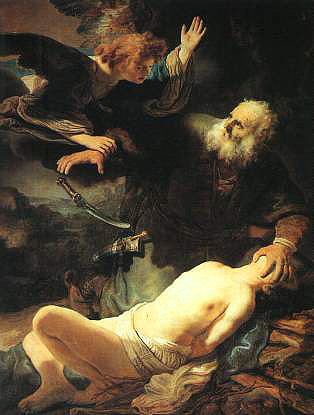
The Sacrifice of Isaac

(Second Sunday of Lent (B): This homily was given on March 12, 2006 at St. Pius X Church, Westerly, R.I. by Fr. Raymond Suriani. Read Genesis 22: 1-18; Mark 9: 2-10.)

[For the audio version of this homily, click here:Second Sunday of Lent 2006]


Hold on—but not too tightly.

This is one of the keys to doing God’s will on this earth. It’s also one of the keys in helping others to do the will of God in their lives.

“Holding on,” in the sense that I’m using the expression in this homily, is something all of us do every day, whether we are conscious of it or not. Specifically, we hold on to other people. That is to say, we rely on them; we develop bonds of friendship and affection with them. We do that because we’re social beings. As John Donne once said, “No man is an island.” We grow up in families; we attend schools; we live in neighborhoods and communities. This is how God created us. In fact, it’s one of the reasons why his Son established a Church (a community of believers). As we’re told in the very first paragraph of the new Catechism: “[God] calls together all men, scattered and divided by sin, into the unity of his family, the Church.”

But there’s a danger that comes with “holding on” to other people in this life, and we need to be aware of it. The danger is that we will hold on to them too tightly. This happens whenever we try to control or manipulate someone for our own selfish ends—by putting them, for example, on a “guilt trip.”

Have you ever heard something like this on your voice mail or answering machine?—“Hello, Johnny, this is your mother calling. You remember me, don’t you? I’m the lady who brought you into this world (after 3 horrible days of labor, as I recall!). I’m also the one who made all those sacrifices for you for 25 years. I hope you come to see me soon. I’m so lonely, you know. I just sit around here all day and stare at these four ugly walls. And then I cry. But don’t worry about me—I know you’ve got your own life to live. Goodbye. Have a nice day.”

Have you ever heard anything like that before? That’s a perfect illustration of what it means to hold on too tightly.

Now if we’re being honest, we will admit that this is a state of mind that can affect any one of us—at least from time to time. But I would say that parents are especially vulnerable to it, simply because of their great love for their children. The thought occurred to me in preparation for this homily: There are probably priests in the world today who never should have become priests!

So why were they ordained?

Simply because in one way or another they were pressured into it by one or both of their parents! Of course, there are also men out there who were called to the priesthood by God and who should have become priests, but never did— also because of parental pressure. (The latter, I think, is far more common these days.)

By the same token, there are men and women who married the wrong person because of interference from mom and dad or some other member of the family; and there are others whose marriages have broken up because of family meddling.

Whenever we try to control or manipulate another human being—even if we do it in the name of love!—we’re holding on to them too tightly. Much too tightly.

This is also a tendency we have to battle when someone close to us passes away. As many of us know by experience, “letting go” of loved ones who have died is sometimes extremely difficult. Those of you who were blessed to have your parents for 70 or 80 years; those of you who lost your spouse after 40 or 50 years of marriage—you know exactly what I’m talking about, don’t you? It was a struggle (and perhaps still is a struggle) to let go of them on an emotional level.

I knew a woman many years ago who was deeply in love with her husband. They had been married over 40 years, and they were constantly together. He suffered a massive heart attack one day at work, and died shortly thereafter. She was a woman who was in church every Sunday and sometimes even during the week, but in her grief she actually tried to take her own life a few months after her husband passed away. Without a doubt, she was holding on to him much too tightly. She needed to let go of him emotionally—even though it was extremely painful and difficult.

I mention this today because it’s exactly what Abraham had to do with respect to his son, Isaac; it’s also what Peter, James and John had to do with respect to Jesus.

In asking Abraham to sacrifice his son on Mount Moriah, God was challenging him to “let go”. In effect, the Lord was saying to him, “I know how much you love this boy. He’s the child you waited 100 years to have; he’s the child through which my promises to you will be fulfilled. And I have a marvelous plan for his life. Will you, Abraham, allow me to fulfill that plan, or will you stand in the way? Your job as a parent is to love and care for your son: to instruct him in the truth; to affirm him in the good he does; and to discipline him when necessary. But you are not the Lord of his life, I am! So do not cling to him too tightly! Let go of him now, so that he will be free to do what I want him to do, and fulfill my perfect plan for his life.”

Something similar happens in the story of the Transfiguration of Jesus, which we heard a few moments ago in that Gospel text from Mark 9. Remember, when this event occurred historically, Peter, James and John had been living with Jesus for 3 years. In the process, they had come to rely on his physical presence with them. And that’s completely understandable! Whenever they wanted help, guidance, or direction, all they had to do was walk up to our Lord and ask him for it. And they did. We all would have done the same thing if we had been in their shoes.

Well, within a few short weeks all that would change: Jesus would be crucified, and he would never again be with them in exactly the same way. Yes, he would always be with them spiritually and sacramentally—but that’s different than the way he was with them during the 3 years he was walking around Palestine! To prepare them for this radical change, Jesus allowed Peter, James and John to see him transfigured on Mount Tabor. His message to them was, “Remember what you’re seeing here, my friends. You have been holding on to me tightly for 3 years by relying on my physical presence with you. But within a few weeks I will be crucified, and you will be forced to let go. And yet, I will still be with you. In fact, I’ll be with you always until the end of the world. See me transfigured; see my divinity! So you will still be able to hold on to me—but you’ll have to learn to do it in a very different way.”

Eventually, thank God, they learned the lesson.

So did Abraham, with respect to Isaac. He held on to his son in love (as any good father would)—but not too tightly.

Let’s pray that in our relationships with other human beings on this earth—especially our relatives and close friends—we will do the same.

Monday, February 27, 2006

Her Race Wasn’t Over—And Neither Is Ours!

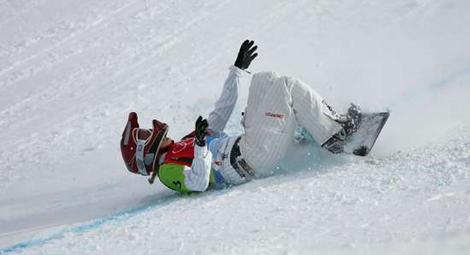
Lindsey Jacobellis tumbles her way to silver.

(First Sunday of Lent (B): This homily was given on March 5, 2006, at St. Pius X Church, Westerly, R.I., by Fr. Raymond Suriani. Read 1 Peter 3: 18-22; Mark 1: 12-15.)

[For the audio version of this homily, click here: First Sunday of Lent 2006]


Her race wasn’t over—but she acted like it was.

And it cost her the gold medal.

I’m talking about Lindsey Jacobellis, the U.S. Olympic snowboarder, who was ahead by fifty yards in the women’s snowboard cross final a couple of weeks ago in Torino, Italy, with only about a hundred yards left in the race.

She was literally coasting to an easy victory—one of the easiest of her career—until she allowed pride to get the better of her. (And you all know what the Bible says about pride, right? In Proverbs 16: 18 it says that pride precedes a fall! Someone needed to quote that line to Lindsey before the race began.)

In a moment she will never forget as long as she lives, she decided to showboat a little for the cameras during her second-to-last jump by reaching down and grabbing hold of the back of her snowboard (a move that snowboarders call “method air”).

And that’s precisely what she did. Unfortunately, however, when she came back down to earth, she slipped, fell, and tumbled off the course just a few yards from the finish line. She tried as quickly as she could to get back on track, but it was too late. Those few short seconds were more than enough time for her nearest competitor, Tanja Frieden of Switzerland, to pass her, cross the line, and win the gold medal. Lindsey had to settle for the silver.

From the moment Lindsey Jacobellis left the starting gate, until the moment she finally crossed the finish line, her race wasn’t over.

And neither, my brothers and sisters, is ours! Our race is also not over! How important it is for us to understand that! Here, of course, I’m not talking about snowboard racing (as a dedicated skier, I don’t even like snowboarding!). Rather, I’m talking here about life—this earthly life we’re all blessed to be experiencing right now! St. Paul, on more than one occasion, made this comparison in his letters. He compared this mortal life of ours to a race, the prize of which is eternal life in God’s heavenly kingdom.

That, I would say, is a very fitting analogy. It’s definitely one that Lindsey Jacobellis could easily understand, given her recent experience at the Olympics.

She missed out on the big prize because she made the fatal mistake of thinking that her snowboard race was over when it really wasn’t.

Well, believe it or not, the very same thing can happen to us with respect to the ultimate prize of eternal life, if we make the serious mistake of becoming complacent and thinking that we’ve already “arrived” (spiritually speaking).

In today’s second reading from 1 Peter 3, for example, the very first pope reminds us that sanctifying grace—the grace Jesus won for us by his passion, death and resurrection— the grace we need in our souls in order to get into heaven—comes through the sacrament of Baptism. Noah and his family in the Old Testament were saved by “passing through” the waters of the great flood. That event, Peter says (and here I quote) “prefigured Baptism, which saves you now.” In other words, Jesus Christ, our Lord and Savior, gives to each of us the grace of salvation, as we “pass through” the waters of the baptismal font.

That’s wonderful. That’s good news! But, unfortunately, it leads some Catholics to mistakenly believe that they’ve got it made! They don’t think they need Mass; they don’t think they need Confession; they don’t think they need to pray every day; they don’t even think they need to live a morally upright life. After all, they’ve been baptized! They’re card-carrying members of the Church! They’ve been saved!

Like Lindsey Jacobellis, they act as if their race is over—but it isn’t! Yes, it’s true, Baptism did bring them sanctifying grace. But that grace can be lost through mortal sin! And committing a mortal sin is a very real possibility, as long as our hearts are beating and we still have breath within us.

This is one of the reasons why Lent is so important! This is why Lent, for all its challenges, is really a great blessing! In fact, if someone ever says to you, “What’s the point of Lent? Why do you give up things and pray more and perform more acts of charity during this season of the year?” you should respond, “It’s because I know that my race isn’t over yet! It’s because I know that I need this season. I have a prize that I’m seeking: HEAVEN! And I’m bound and determined to stay on the narrow road that leads to that goal. But I also know how weak I am. I know that, just like Lindsey Jacobellis, I can easily let pride get the better of me. And when that happens, mortal sin isn’t very far away. So during these 40 days of Lent I make a special effort to deal with my weaknesses: I pray more frequently, because I know that through prayer (and especially through the Mass) I receive the grace I need to stay on course—on that narrow road that leads to life. I fast and engage in other acts of self-denial to discipline my body and mind, so that my flesh doesn’t lead me off course and into serious sin. And I give alms and perform extra works of charity to lessen my attachment to the things of this world. Because the more I’m attached to money and objects, the easier it is for me to get off track.”

Let’s pray at this Mass for ourselves and for one another: that we will have the good sense to take a lesson from Lindsey Jacobellis and never act as if our race is over—until it is!

And yet, as we do this, we need to remember that there is one very big difference between her experience on the race course during the Olympics, and our experience in life . . . .

Once she made her prideful mistake, Lindsey Jacobellis couldn’t do anything about it. As soon as she hit the snow and veered off that race course, her fate in the final of the women’s snowboard cross was sealed. The gold medal was gone.

But if we should happen to get off course at some point by committing a mortal sin, all is not lost. As long as we’re still alive, we have the opportunity to get back on track and win the eternal prize. All we need to do is enter one of those little rooms on either side of the church and say, “Bless me, Father, for I have sinned . . . “

May all those Catholics who have fallen and are presently off the race course, do that during this season of Lent.

Friday, February 10, 2006

He Tuned Out Distracting And Dissenting Voices—And He Was Greatly Blessed!


(Sixth Sunday of the Year (B): This homily was given on February 12, 2006, at St. Pius X Church, Westerly, R.I., by Fr. Raymond Suriani. Read Mark 1: 40-45.)

[For the audio version of this homily, click here: Sixth Sunday of the Year 2006]


He was a man who “tuned out” distracting, dissenting voices. And in the process, he was greatly blessed!

I’m talking about the leper in today’s Gospel story from Mark 1.

This is something we can discern once we look back at the first reading. There Moses (the author of the first 5 books of the Bible) proclaims the Hebrew law concerning lepers. In the last two verses of the text, it says: “The one who bears the sore of leprosy shall keep his garments rent and his head bare, and shall muffle his beard; he shall cry out, ‘Unclean, unclean!’ As long as the sore is on him he shall declare himself unclean, since he is in fact unclean. He shall dwell apart, making his abode outside the camp.” (Leviticus 13: 44-46)

All of which means that this sick, diseased man shouldn’t have been anywhere near Jesus! He should have been with his fellow lepers, miles away from those who were fit and healthy.

Given that fact, what do you think the eyewitnesses of this event were saying? What do you think their response was when they saw this leper approaching? Do you think they were saying, “Come, friend; come closer to us; come and see Jesus”?

I don’t think so!

They were probably screaming at the guy: “Get away! What the matter with you? Don’t you know the law? Get out of here!”

This leper, thankfully, was not deterred! As I said in the first line of my homily, he “tuned out” all the distracting and dissenting voices around him (that is, the voices that were commanding him to stay away). He tuned them out, came right up to Jesus, and knelt down within an arms-length of our Lord. (We know that, incidentally, because St. Mark says that at one point Jesus reached out with his arm and touched the leper with his hand.)

And because he tuned out all the negative voices and then “tuned in” to Jesus, this leper was greatly blessed. He was, as we heard a few moments ago, completely healed of his horrible disease. Perhaps the words of today’s responsorial psalm refrain were his words afterward: “I turn to you Lord, in time of trouble, and you fill me with the joy of salvation.”

What a great lesson there is here for all of us—and in particular for our young people: If you want Jesus to bless your life in extraordinary ways, then you need to “tune in” to him, AFTER YOU TUNE OUT THE DISSENTING AND DISTRACTING VOICES OF THIS WORLD!

Needless to say, in our extremely noisy, anti-God culture, this is a challenge—a very big challenge! It’s hard for all of us to “shut out” the voices of dissent and distraction; it’s equally as hard to “tune in” to the person and message of Jesus.

I’ll give you one example to illustrate the difficulty. . . .

A few weeks ago, we began to prepare for this year’s trip to the Steubenville East youth conference, which will take place (as always) in mid-July. We did that by gathering some of the chaperones together for a brief meeting here in church. During the course of our discussion that night, some of the “veteran” adults (i.e., those who’ve been coming for many years) made an interesting observation. They noted that, on our most recent trips to the conference, we’ve had to deal with many more “resistant” and “disconnected” teens than we had to deal with in previous years.

Some resistance, of course, is always to be expected. God never forces himself on anyone; he always respects a person’s free will. Even when Jesus preached the Gospel in person 2,000 years ago, some freely resisted and refused to say Amen to what they heard.

Thankfully, most of the young people who come with us each year do open up to the Lord and have a great experience at the conference. But some don’t. Unfortunately, the number of those who “don’t” has noticeably increased of late—and our adults have noticed.

Personally, I don’t think this is peculiar to our group, either. I think every group that goes has had a similar problem.

Why?

We’re convinced that one of the biggest reasons for this is that many of our teenagers are no longer getting away from distracting, dissenting voices when they attend the conference! For the most part they used to, but not anymore—especially because of the new technology that’s out there.

If a teen goes to Steubenville East, for example, with a negative attitude (as some do!), and then he spends every free moment he has on his cell phone, talking with his friends back home—friends who are reinforcing his negativity with their discouraging and sarcastic comments—what chance does that young person have of opening up to Christ at some point during the weekend?

The answer is: Very little.

Teenagers, that’s why we will be very strict this year—stricter than ever before—when it comes to cell phones, pagers, ipods, CD players, etc!

If we find one of those little items on your person, we will confiscate it immediately! You’ll get it back when we return to St. Pius on Sunday.

We will do this, of course, for your own good: so that you will not be negatively influenced when you’re there! Remember, the reason they call it a “retreat,” is because that’s what you’re supposed to do—retreat! You’re supposed to pull away from your everyday circumstances, activities and acquaintances, so that you can tune in to Christ on a deeper level, and receive the graces and blessings that he wants to give you!

A man who made an Adult Search at St. Dominic Savio Youth Center many years ago reminded me the other day that, when he arrived at the retreat house on Friday evening, the people in charge took his watch away! And they kept it for the entire weekend! That’s because they didn’t even want “time” to be a distraction for him on the retreat! A woman in the parish told me that the same thing happened to her and her husband when they made a Marriage Encounter several years back.

So this is obviously not something that’s peculiar to teenagers! All of us, young and not-so-young, are easily affected by negative voices that seek to keep us from focusing on God, and from coming to Jesus in the way that this leper did.

He was a man who consciously and resolutely “tuned out” the distracting and dissenting voices around him.

If we want to be blessed as powerfully as he was blessed, we need to follow his example.

May the Lord help us all to do so.