Saturday, June 17, 2006

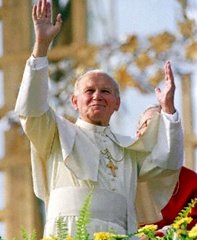
John Paul II: A Father Who Gave His Best

John Paul II, exercising his 'fatherly' role.

(Corpus Christi 2006: This homily was given on June 18, 2006 at St. Pius X Church, Westerly, R.I., by Fr. Raymond Suriani. Read Hebrews 11: 9-15; Mark 14: 12-16, 22-26.)

[For the audio version of this homily, click here: Corpus Christi 2006]


About a week after John Paul II died last year, Kathleen Parker, a syndicated columnist from Florida, wrote an op-ed piece that appeared on the opinion page of USA Today. The purpose of her article was to reflect on our former pope’s incredible popularity, which extended far beyond the visible bounds of the Catholic Church. As she rightly noted, John Paul II was deeply admired and deeply respected by many non-Catholics, and even by some who would classify themselves as “non-religious”.

Ms. Parker then attempted to explain this surprising phenomenon. And she summed up her reasoning in one very simple word: Father! In her view, John Paul II was loved and respected by so many people of various backgrounds, because of the way he exercised his spiritual fatherhood.

Please hear that, dads, on this Father’s Day!

She wrote:

[John Paul II] was, of course, the ‘Holy Father.’ Il Papa. But he was more than that. He was the transcendental father figure. The symbolic Man. Adam in 21st-century flesh. Leader, teacher, disciplinarian, protector of hearth and home, he embodied all the traits of the uppercase Father.

(By the way, I should mention at this point that Ms. Parker herself is not a Catholic, which only makes her comments more noteworthy and more extraordinary.)

She went on to say that the very things that would seemingly make John Paul unpopular—his position, for instance, on contemporary moral issues—actually made him more attractive, especially to the young!

Listen to her words:

The pope’s orthodoxy is at least partly why he was so revered. His commitment to principle—his standing apart from and above the fickle passion of the human flock—earned him admiration. We’re not like him, most easily concede. But do we want a pope who is like us? No more, I suspect, than we want a president who is just a guy.

John Paul’s allegiance to principles related to marriage, sex, birth control, homosexuality and other topics that keep the cultural machinery in perpetual spin cycle wasn’t his flaw, but rather his strength. Whether some of us might disagree individually was not his concern. He didn’t rely on focus groups or polls. In his role as quintessential father, the pope was willing to lay down the law even if it meant listening to the foot stomping, wailing, and gnashing of teeth from the little darlings. As the Lord did not say, “If it feels good, do it,” neither did John Paul II.

Her theory as to why all this would be attractive to the youth of today is, I would say, both true and tragic at the same time. She wrote:

Today’s younger generation . . . has grown up . . . notably within divorced families, often without fathers, in a coarsening culture awash with sexual hookups, pornography, unwed parenthood and family disintegration. In the USA today, half of all children will witness the breakup of a parent’s marriage. Forty percent do not live with their father. Before age 18, more than half will spend part of their childhood away from their father. . . .

In such an environment, it is not surprising that a symbolic father figure should have an estimated 2 billion people riveted by his life and death, including throngs of young people, some of whom trekked across oceans and continents to bear witness to his funeral and burial.

The bottom line is this: John Paul II, in his life and in his ministry, reflected the fatherhood of God. Remember what Kathleen Parker said earlier in her article? She wrote, “Leader, teacher, disciplinarian, protector of hearth and home, [John Paul] embodied all the traits of the uppercase Father.”

That “uppercase Father” in heaven, incidentally, gave us his “best” 2,000 years ago when he sent us his only-begotten Son, Jesus Christ: “For God so loved the world that he gave his only Son, that all who believe in him might not perish, but have eternal life.” (John 3: 16)

A good earthly father makes every effort to do the same thing—whether his children appreciate it or not! A good earthly father is someone who strives—like God—to give his best to his children. And that “best” includes much more than money and possessions (in fact, in many respects, money and possessions are only secondary).

To give your best as a father means to be a moral and spiritual leader of your family, and to lead primarily by example. Like John Paul II did. He taught the truth clearly in encyclicals and in other official documents, but first and foremost he lived it!

In this our former Holy Father was a real though imperfect reflection of God, our perfect and eternal Father.

And here’s a point that definitely needs to be highlighted on this feast of Corpus Christi: God the Father gave us his best in giving the world his Son, Jesus Christ. But that’s NOT where it ended. Jesus, in turn, gave us his best—and he continues to give us his best.

How?

First of all, he gave us his “best” 2,000 years ago by offering his life on the cross for the forgiveness of our sins. As today’s second reading reminds us, “He entered once for all into the sanctuary, not with the blood of goats and calves but with his own blood, thus obtaining eternal redemption.” (Hebrews 9: 12)

But Jesus continues to give us his “best”—his very self—sacramentally at every Mass, in and through the Holy Eucharist. We heard about the institution of that gift in today’s Gospel reading: “While they were eating, [Jesus] took bread, said the blessing, broke it, gave it to them, and said, ‘Take it; this is my body.’ Then he took a cup, gave thanks, and gave it to them, and they all drank from it. He said to them, ‘This is my blood of the covenant, which will be shed for many.”

Today, Catholics throughout the world say, “Thank you, Lord, for this incredible gift. Help us to appreciate it more (because we all need to appreciate it more than we do!).

This great gift, of course, really shouldn’t surprise us. Here we simply have a ‘son’ imitating his ‘father’. God the Father gave us his best, and now his divine and only-begotten Son is doing the very same thing by giving us his Body and Blood.

Let me conclude today with a word to the young people, because this has a very practical application to you and to your future . . .

First to the young men here present, some of whom may be called to be spiritual fathers like me, others of whom will be called to marriage and natural fatherhood:

If you want your children to be good, make sure you are a good father, because the apple really doesn’t fall far from the tree! The children God blesses you with in the future, for better or for worse, will tend to follow your example. So if you don’t like what you see in the mirror these days, then change—now!—for their sakes, as well as for yours! Becoming a good father begins at this moment; it doesn’t begin when your wife first conceives a child, or when you get your first parish assignment as a priest. If you want your children to give their best, then you need to be prepared to give them your best—and that means becoming a faith-filled, godly man in the present moment! It means working hard to become a man of good spiritual and moral character—like Pope John Paul II.

And finally, to the young women here present who may feel called to marriage:

Do yourself a big favor: In your search for ‘Mr. Right,’ don’t settle for just anybody. Set your standards high—very high! Look for the kind of man who embraces the spiritual and moral values that will make him a good father. Look for those qualities in him NOW! Don’t think you’re going to “change” him after you’re married, because you probably won’t. Very rarely does that happen, so you shouldn’t count on it. When you date a guy one of your first thoughts should be, “What kind of father will this man make? What will he be able to teach my sons and daughters about God, and truth, and right and wrong? What kind of example will he give? Do I want my children to be just like him someday?”

Because chances are they will be—if he’s their dad.

And perhaps it would be a good idea for all of you—young men and young women alike—to say a little prayer to John Paul II every day. Ask him to pray and to intercede for you, that you will either become a good father—or someday marry one.



Saturday, June 10, 2006

’Over The Hedge’: A Teaching Opportunity

Some of RJ's 'friends'

RJ the raccoon

(Trinity Sunday 2006: This homily was given on June 11, 2006 at St. Pius X Church, Westerly, R.I., by Fr. Raymond Suriani. Read Matthew 28: 16-20.)


[For the audio version of this homily, click here: Trinity Sunday 2006]


A hungry raccoon desperately tries to get a bag of chips out of a vending machine that’s sitting in front of a rest stop on the side of the road.

He does everything he can think of to get the bag to fall to a place where he can grab it, but nothing works.

Then he remembers that a big bear is hibernating in a cave on a hill across the street. He goes into the cave, and there he discovers a mountain of human junk food—obviously either found or stolen by the bear before he began his yearly snooze.

The raccoon piles the food onto a little red wagon and begins to wheel it ever-so-quietly out of the cave.

But then GREED gets the better of him.

He looks back, and he sees the sleeping bear cradling a container of potato chips, and the expression on his face indicates exactly what he’s thinking: “I want those! Even though I’ve got more than enough food here in this wagon, I want those chips!”

So he decides to go back and get them. For a brief moment he reconsiders his decision, but he eventually gives in to the temptation.

That sets off a string of events: the bear wakes up; the wagon and the food are destroyed in an accident; and the angry bear threatens the raccoon with death unless he replaces all the ruined food items within 7 days.

Now I know what some of you are thinking: “Fr. Ray, that’s a little ‘over the edge’.”

To which I respond, “No. But it certainly is ‘Over the Hedge’!” That’s because (as some of the children in the congregation know) what I just described to you was the opening scene of the new movie from DreamWorks films which bears that title.

Although it certainly isn’t perfect, all in all “Over the Hedge” is a very good film—at least in my humble estimation. I say that because it’s a fun, entertaining movie that also teaches a lot of important lessons, not the least of which is how sins like greed can get you into big trouble!

Little RJ the raccoon shouldn’t have been stealing food from Vincent the bear; and he certainly didn’t need that last box of potato chips. But in his greed he just had to have it!

And that caused him not only to get a death threat from an angry Vincent; it also led him to manipulate others for his own selfish ends. In fact, much of the rest of the film is about how RJ uses the other animals in the forest to help him steal food from people in a brand new housing development. The housing development, incidentally, is located on the other side of a big hedge (hence the title, “Over the Hedge”).

I mention this today because of what Jesus says in this Gospel text from Matthew 28.

These are the final words that our Lord speaks to his apostles just before he ascends to heaven. That means they’re EXTREMELY IMPORTANT!

As we all know, the final words a person speaks before leaving this earth very often reveal his deepest sentiments and deepest desires.

And such is the case here.

These final words of Jesus express his deepest desire for us and for every human person. Our Lord says, “Go, therefore, and make disciples of all nations, baptizing them in the name of the Father, and of the Son, and of the Holy Spirit, teaching them to observe all that I have commanded you.”

The first instruction Jesus gives here is to baptize people in the name of the Blessed Trinity: the Father, Son and Holy Spirit. And that should make perfect sense to us, because that’s how people get into the state of grace!

We need to be in the state of grace in order to go to heaven, and we get into that “state” by receiving Baptism in some form.

But even though Baptism is necessary, Jesus knew that something more is also required. You see, it’s one thing to get into the state of grace; it’s quite another thing to REMAIN there!

This is why he gave his apostles (and all of us) another command before he ascended to heaven: the command to teach! To remain in the state of grace, people need to be taught the truth of the Gospel! They need to be taught it, so that they can live it.

Now obviously the best teaching is done by example. A living witness—a good, holy Catholic who lives his faith—is the best kind of teacher.

But God also expects us to teach in other ways; for instance, by using elements of our everyday experience—like current events and popular songs and movies—to convey moral and spiritual lessons to those around us.

And he gives us these opportunities all the time. Like this new DreamWorks film!

As I sat in the theater the other day I thought to myself, “What a great opportunity to teach young people some rock solid biblical lessons that will help them stay rooted in Jesus Christ!”

Needless to say, if I had children grade 2 and older I would definitely take them to see this movie. And I can tell you what I would say to them on the way home. I’d keep the radio off, and I’d try to get my children to PROCESS what they just saw on the screen from a spiritual, Christian perspective. I’d do that by saying things like this:

“So what did you think of the movie?”

“That RJ was pretty funny; he was quite the character. But he got himself into a lot of trouble didn’t he?”

“See what happens when you get greedy and you steal? He just had to have those chips, didn’t he? You know, God gives us that seventh commandment—‘Thou shalt not steal’—for a reason!”

“And what did you think of the way RJ treated those other animals? Wasn’t that terrible? He said he was their friend, but he really wasn’t, was he?”

“Have any of you ever felt like that before—like somebody used you?”

“This is why it’s so important to follow Jesus. He wants us to share, and not be greedy, and to really love and care about other people.”

“And isn’t it interesting how the different animals spoke of themselves as a ‘family’—even though they weren’t related like we are? I think it’s a lot like the Church, don’t you? The Church is God’s spiritual family. Even though we’re not related to most of the people we go to church with, we’re all brothers and sisters of Jesus, and we have God as our one, true Father in heaven.”

The conversation would certainly go on from there, but I’ll stop at this point because if I go any further I might give away the ending of the movie—and that might ruin things for those of you who are planning to see it.

But you get my point. We need to make the conscious effort to use elements of our everyday experience to teach others—especially our young people—the timeless truths of the Gospel; because the world is always teaching them the opposite message. The world is always teaching them—and feeding them—its lies!

“Go, therefore, and make disciples of all nations, baptizing them in the name of the Father, and of the Son, and of the Holy Spirit, teaching them to observe all that I have commanded you.”

If our Lord were standing here this morning, he might add to those words by saying, “And make sure you don’t miss any of the teaching opportunities I give you!—because there will be lots of them. They will be literally everywhere—even in funny little animated films like ‘Over the Hedge’.”


Sunday, June 04, 2006

Pentecost, The Ordained Priesthood—And The Priesthood Of All Believers

The former deacon (left) with his favorite priest!

(Pentecost 2006 (B): This homily was given on June 4, 2006 at St. Pius X Church, Westerly, R.I., by Fr. Raymond Suriani. Read Acts 2: 1-11; 1 Corinthians 12: 3b-7; 12-13; John 20: 19-23.)

[For the audio version of this homily, click here: Pentecost 2006]


Deacon Greg Stowe, who was stationed here at St. Pius last summer, shall henceforth be known as “Father Greg Stowe.”

That’s because, along with two other men from our diocese, he was ordained a priest yesterday morning at the Cathedral of SS. Peter and Paul in Providence by our bishop, Thomas Tobin.

This year, our diocesan ordinations have taken place on the Saturday of Pentecost weekend. Pentecost, of course, is the day the Church celebrates the coming of the Holy Spirit on the apostles 50 days after Easter.

It’s not necessary that priestly ordinations take place on this particular weekend (they can be celebrated at other times of the year as well)—but it’s extremely meaningful when they do. That’s because on the very first Pentecost 2,000 years ago, the 12 apostles were empowered by the Holy Spirit for their missionary activity as priests. They had been ordained by Jesus on Holy Thursday at the Last Supper, but here—in the Upper Room at Pentecost—they were anointed by the Holy Spirit so that they could go forth and win the world for Jesus Christ.

And, as we heard in today’s first reading, they didn’t waste any time getting right to work. Literally within a few minutes after the Spirit’s descent, these men were out on the streets of Jerusalem preaching the Good News to the people there.

But this was not the first time the apostles had received the Holy Spirit after Easter, was it? (If you were paying close attention to the Gospel from John 20, you know that!) The first time they had received the Spirit after Jesus rose from the dead was on Easter Sunday itself.

However back then, the purpose of the Spirit’s coming was different. At Pentecost, he came to anoint them for their priestly mission; at Easter, he had come to give them the power to forgive sins in the name of Jesus Christ.

For Father Greg and those ordained with him, the Spirit came for both of those purposes yesterday. He came so that they could they could fulfill their priestly mission in this life, and he came so that they could forgive sins.

That means you can all go to Confession to Father Greg the next time you see him. (And that may be a good idea, because new priests are usually pretty easy in the penances they give!) It also means that even I can go to Confession to him (if the two of us can stop our usual joking around for a few moments!).

Now all this, believe it or not, has a direct application to your lives as lay people. If it didn’t have a direct application, I wouldn’t have brought it up in this homily.

The Holy Spirit has come to most of you in Baptism and in Confirmation. The Holy Spirit will also come to you outside of those sacraments on a daily basis if you ask him in faith.

Here’s what the Catechism says about those who are baptized. This is from paragraph 1268:

“The baptized have become ‘living stones’ to be ‘built into a spiritual house, to be a holy priesthood.’ By Baptism they share in the priesthood of Christ, in his prophetic and royal mission. They are ‘a chosen race, a royal priesthood, a holy nation, God's own people, that [they] may declare the wonderful deeds of him who called [them] out of darkness into his marvelous light.’ Baptism gives a share in the common priesthood of all believers.”

Father Greg and I share in the ordained priesthood of Jesus Christ. But long before either of us received the sacrament of Holy Orders, we both shared in the common priesthood of all believers by our Baptism.

And so do you.

Thus it should come as no surprise that Jesus sent you his Holy Spirit in Baptism for two of the same reasons he sent the Holy Spirit to us in the sacrament of Holy Orders: so that you will forgive sins, and so that you can fulfill your priestly mission in this life.

You, of course, don’t have the power to forgive sins in the name of Jesus Christ on behalf of the Church (you need to be ordained to do that). But you do have the power to extend forgiveness on a personal level to all those who have offended you in some way! And God expects you to do that, as he expects me to do that. Jesus said, “Forgive, as you have been forgiven.”

“But, Father Ray, that’s hard.”

That’s right—which is one of the reasons why Jesus sent us the Holy Spirit! He sent the Spirit to help us forgive and do lots of other things that we couldn’t possibly do on our own!

Forgiveness takes effort; forgiveness often takes time—but forgiveness IS possible, by the power of the Holy Spirit.

And forgiveness is good for us—in addition to being good for our relationship with God and good for our relationships with other people.

The other day I read a little article on-line by Dr. Diana Robinson, a psychologist. There she gave these powerful words of warning: “Recognize who is being hurt by your non-forgiveness. Does the other person burn with your anger, feel the knot in your stomach, experience the cycling and recycling of your thoughts as you re-experience the events in your mind? Do they stay awake as you rehearse in your mind what you would like to say or do to ‘punish’ them? No, the pain is all yours.”

Holy Spirit, help us to forgive—out of obedience to Jesus and for our own good!

As I said earlier, the Spirit also came to the 12 apostles on Pentecost for another reason: so that they could fulfill their priestly mission in this life.

The Spirit has come to all of you who are baptized for the same reason! Believe it or not, you too have a “priestly mission” here on earth. It’s a little different than the one Fr. Greg and I have as ordained priests, but it’s just as valid. And it’s extremely important in the eyes of God.

St. Paul alluded to this mission in today’s second reading from 1 Corinthians 12 when he wrote, “There are different kinds of spiritual gifts but the same Spirit; there are different forms of service but the same Lord; there are different workings but the same God who produces all of them in everyone. To each individual the manifestation of the Spirit is given for some benefit.”

One of the most important “services” you are called to render as part of your “priestly mission in life”—aside from simply being a good example of Catholic living to those around you—is “feeding” your brothers and sisters in Christ with the truth. If you’re a parent, incidentally, that activity begins with your children! And it involves more than just taking them to Mass and sending them to CCD! It means making every effort to create a Catholic environment in your home and to instill in them Gospel values.

Father Greg Stowe was ordained a priest yesterday by the power of the Holy Spirit. But that event probably would never have taken place if his parents had not exercised their priestly ministry well by raising him in the faith!

They fulfilled their mission as Catholic parents by the power of the Spirit, and because of that Fr. Greg can now fulfill his ordained ministry by the power of the same Spirit.

So today we pray for Fr. Greg and those ordained with him yesterday at our cathedral. May they be instruments of the Lord’s forgiveness for many people, and fulfill their priestly mission, by the Spirit’s power.

And may each and every one of us do the same, according to our personal calling in this life.

Friday, May 26, 2006

It’s Your Choice: You Can Be ‘Consecrated In Truth’ Or ‘Desecrated In Lies’

Is yours a place of 'desecration'?

(Seventh Sunday of Easter (B): This homily was given on May 28, 2006 at St. Pius X Church, Westerly, R.I., by Fr. Raymond Suriani. Read Acts 1:15-26; John 17: 11-19.)

[For the audio version of this homily, click here: Seventh Sunday of Easter 2006]


A teenager from Westerly High wrote this on his blog a couple of weeks ago:

Yesterday, at school, I was sitting in my Health II class as a guest speaker was talking about different laws regarding sexual behavior. As he reviewed the three levels of sexual assault, he alerted the class to the fact that fornication is indeed illegal, and although an offender probably wouldn't get locked up for it, there would be consequences if his or her actions were brought to court. The room became dead silent, and a heartbeat after he had made this statement, a young woman raised her hand and asked, "I don't understand. I thought that the Catholic Church was the only religion that forbade sex before marriage. How can the government impose morals on us like that?" The speaker was equally confused at the question, "Uh... It's the law. It's there to protect you. Morality has nothing to do with it." This was followed by a string of disagreements from the rest of the class, and we literally could not progress with the conversation because everyone would keep coming back to this.

I have it on good authority that two devils from hell were listening in on this discussion when it took place the other day. And as they listened intently they also laughed—like hell (if you’ll pardon the expression).

One said to the other:

Can you believe how stupid these humans are? Our father, Satan, told us we’d have great success in clouding their thoughts and poisoning their minds, but he didn’t tell us it would be this easy! And what a job we’ve done with this young high school student! We should be so proud (and, of course, we are!). She’s listened to all the lies and propaganda we’ve thrown at her in her music, and through the mass media, and she’s bought the whole package—hook, line and sinker! So much so that she now actually thinks that our enemy’s Church is against sex. Isn’t that amazing? She doesn’t realize that our enemy was the one who invented sex in the first place! He’s the one that said to the first man and woman, “Be fruitful and multiply.”

She also thinks that our enemy’s Church is anti-American and anti-freedom. That’s awesome, because it ultimately will cause her to leave her faith in church and keep it out of her everyday life as an American citizen.

And as if all this wasn’t good enough, she’s even come to believe the lie which says that law and morality are mutually exclusive categories! How great is that?!!! She’s been so deluded by us that she can’t see the obvious truth that every good law—good, that is, from our enemy’s perspective—is rooted in a moral principle!

But perhaps our greatest victory today was with this guest speaker who came to talk to her class. After all, he was the adult who should have set them straight! But out of fear—out of a desire to be ‘politically correct’—he only made matters worse! In talking about the law, he merely reinforced the teenager’s error when he said, “Morality has nothing to do with it.”

That was music to our ears, was it not?

Our father in the eternal flames will be so pleased with us for what we’ve done in this little Rhode Island town today. Perhaps he will give us a big de-motion for our efforts!

Let’s hope so!

“Lifting up his eyes to heaven, Jesus prayed, saying: ‘Father . . . I do not ask that you take them out of the world, but that you keep them from the evil one. They do not belong to the world any more than I belong to the world. Consecrate them in the truth. Your word is truth. As you sent me into the world, so I sent them into the world. And I consecrate myself for them, so that they also may be consecrated in truth.’”

We heard those words in today’s Gospel text from John 17.

This incident at Westerly High provides a vivid illustration of WHY Jesus prayed that prayer to his heavenly Father on the night before he died: He knew how prevalent the lies would be! He knew that the lies which can undermine faith and destroy virtue—and ultimately lead people to hell—are literally all around us! As we all know, the kind of interaction that took place in that classroom the other day on Ward Avenue also takes place on a daily basis in many other locations.

In his prayer in John 17, Jesus indicates that if we want to be kept from the evil one (in other words, if we want to be protected from his lies and evil promptings), we must be consecrated in the truth of the Gospel. In other words, we must know the truth, and believe the truth, and live the truth—by the grace of our Baptism. And that makes perfect sense, does it not? If we know and believe and live the Gospel message, we will be holy. And that holiness will keep us out of hell and get us into heaven when we leave this life!

But how do we know the truth? How do we know that what we’re hearing is the Gospel message in its fullness?

The simple answer is that we know the truth of the Gospel through the power of the Holy Spirit, and with the assistance of the magisterium of the Church. The magisterium is the teaching authority that JESUS established in his spiritual family. It consists of the pope and the bishops in union with him. When they teach as a body either in a council document or in some other official proclamation concerning faith and morals, they teach with the authority of Jesus Christ himself (which means that we’d better take what they say seriously!).

In this regard, I don’t think it’s a coincidence that today’s first reading was about the choosing of Matthias. That, I would say, was definitely arranged by the Holy Spirit. Matthias was the man who was chosen by God to replace Judas Iscariot as one of the 12 apostles, after Judas had committed suicide.

At one point in this scene St. Peter stands up and quotes a line from the book of Psalms (“May another take his office”), indicating that an office—that is to say, an official position in the Church’s magisterium—was vacant, and it needed to be filled as soon as possible, so that the truth in its fullness could be proclaimed as God wanted it proclaimed.

When Jesus indicates in John 17 that a person needs to be consecrated in truth in order to be protected from the evil one, he talking about the truth that would soon be taught by St. Matthias, and St. Peter, and the other 10 apostles—and by their modern-day successors, the bishops!

We find their teaching summarized, incidentally, in that book known as The Catechism of the Catholic Church. How often do you consult that most important reference book of Catholic teaching? Do you ever consult it?

The thought occurred to me as I was preparing this homily: Wouldn’t it be great if Catholics were as excited about reading the Catechism as many of them are about reading The DaVinci Code?

In The DaVinci Code they read lie after lie and they can’t get enough of it; in the Catechism they get the pure, unadulterated truth, and they want nothing to do with it.

How tragic—and how revealing!

When I read that story on that teenager’s blog the other day, I realized that all of us, young and not-so-young, face a very simple but challenging choice throughout our lives: We can choose either to be consecrated in truth by following the Church’s magisterium, or we can choose to be desecrated in lies by listening to the world.

Consecrated in truth or desecrated in lies.

Jesus wants us to choose the first—he prayed for that on the night before he died. The two little devils from hell and their diabolical father want us to choose the second.

By the grace of God may we all choose “consecration” and not “desecration”—today and every day.