Sunday, April 24, 2005

Lessons From A Life Well-Lived

(Fifth Sunday of Easter (A): This homily was given on April 24, 2005, at St. Pius X Church, Westerly, R.I. Read John 14: 1-12.)

[For the audio version of this homily, click here: Fifth Sunday of Easter 2005]


This homily is entitled, “Lessons From A Life Well-Lived.”

The well-lived life I’m speaking of is that of our former Holy Father, Pope John Paul II.

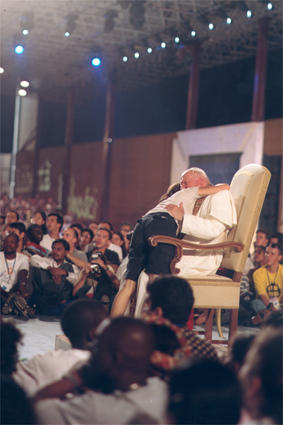
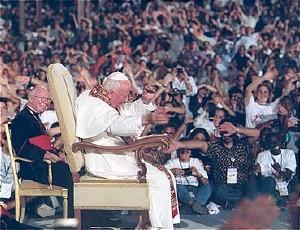
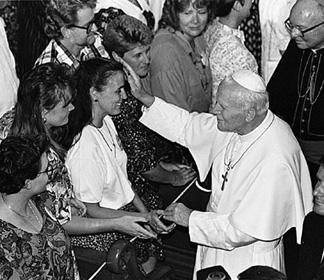
The lessons given by John Paul’s life are definitely for all of us, but today I will apply them specifically to the young people in the congregation. As we all know, our former Holy Father had a tremendous love for the young. That was clearly evident whenever a World Youth Day was celebrated. He inspired young people time and time again with his presence and with his words. And he definitely was inspired and energized by them—even when he was sick.

This homily topic came to mind when I read the first verse of today’s Gospel text from John 14. The setting here is the Last Supper. Jesus has just washed the feet of his apostles, and now he gives them what amounts to his final sermon—what Biblical scholars refer to as his “Last Discourse.”

Jesus begins this farewell teaching with these very powerful words: “Do not let your hearts be troubled. You have faith in God; have faith also in me.”

Our Lord knew that within a few short hours his close friends would be plunged into a terrifying situation. He knew how fear—intense, overwhelming fear—would threaten to lead them into sin and destroy their faith. And so, like a Good Shepherd, he gave them a warning, and urged them not to be afraid.

That, of course, was precisely the message that John Paul II gave to us on the balcony overlooking St. Peter’s Square on October 22, 1978, when he was introduced to the world as the new pope. He said, “Be not afraid!”

We didn’t know it at the time, but now it’s clear that this was actually a very humble statement on the part of the new Holy Father. Given what he had already done in Poland in openly opposing communism, and given what he would soon do as pope in continuing that fight—and in promoting human rights and the full teaching of the Gospel—he could have come out on the balcony that day and said, in total honesty, “My brothers and sisters in Christ, be not afraid—because I’m not afraid! Follow my example!”

But he was much too humble to do that!

So he simply let his actions verify his words—for over 26 years!

Now his earthly life is complete, his ministry is finished—but his message lives on!

And so, in a certain sense, our former Holy Father continues to say—especially to the young—“Be not afraid!”

“Be not afraid, first of all, to follow Christ!”— “Don’t be afraid to give yourselves completely to Jesus. He has a plan for your life, as he had a plan for mine. Stay close to him, so that you will discover what that plan is.”

“Be not afraid, therefore, to go to Confession.”—“Don’t let Satan keep you away! Don’t be afraid of being faithful to Mass and daily prayer! If you’re going to stay close to Jesus and discover his plan for your life, prayer and the sacraments are essential. That’s what did it for me—especially in my youth, when I suffered the loss of so many of my loved ones. My sister died in her infancy; my mother died when I was only 9; my brother, a young and promising doctor, died when I was 11 after he caught scarlet fever from one of his patients; and my father died in our apartment when I was only 20 years-old. I found him dead one day when I came home from work.

By the time I turned 21, I had no immediate family left on this earth. But Mass and the sacraments and my Catholic faith sustained me during those difficult days and years. They will sustain you too, if you let them—if you take them seriously.”

“Be not afraid to serve others!”—“In one of the Documents of Vatican II (which I helped to write), it says, ‘Man . . . cannot fully find himself, except through a sincere gift of himself.’ Thinking only of your own wants and desires will ultimately make you miserable in this life. If I had thought only of myself after all the members of my family had died, I would have been filled with self-pity and anger. But I learned to serve others, and that made all the difference.”

“Be not afraid to stand up for the truth of your faith.”—“Think of the dangers I faced every day as a bishop of the Church in a communist country. If I could deal with that type of opposition, then you can certainly be true to your Catholic faith in your school, in your workplace, and with your friends.”

“Be not afraid to forgive your enemies.”—“This, after all, is Jesus’ command to us. And yes, I know it’s not easy! Do you think it was easy for me to forgive the man who shot me in St. Peter’s Square in 1981? It was not, but I did it anyway. Do you think it was easy to forgive those men and women—especially in the Catholic Church—who slandered me and openly defied me for the 26 years I served as pope? It was not. But I sought the grace I needed for the task and I forgave them all—joyfully—because it’s always a joy to do what God wants!”

“Be not afraid to say, ‘I’m sorry,’ to those you hurt.”—“In preparation for the new millennium, I spent a great deal of time asking forgiveness—not for the sins of the Church (because the Church as such does not sin)—but rather for the sins of members of the Church throughout the centuries. Some people—even some good people—did not want me to do this. But when you say you’re sorry, it tears down the walls between you and others, and then God can work in beautiful and powerful ways. Did you see how the Lord brought so many people from different backgrounds together for my funeral two weeks ago? In some respects, that was a tremendous miracle—a miracle born of forgiveness.”

“Be not afraid to embrace your cross, and to use your suffering for good.”—“I did not like having Parkinson’s Disease. I did not like the restrictions it put on me. I did not enjoy getting old. I could no longer ski, and hike and kayak and do all those things I enjoyed doing most of my life. I could not be as active as I was in my early years as pope. But I offered it all up to God like a prayer—for the good of the Church and the world. Learn to do the same with your crosses. Don’t waste them.”

And finally, “Be not afraid to die.”—“Our faith tells us that physical death is not the end. Jesus reminded us of that truth in today’s Gospel when he said that in his Father’s house there are many dwelling places. So live the Gospel, remain in the state of grace, and you have nothing to fear. Remember the words I spoke to my personal secretary just before I died: ‘I am happy, be it yourselves as well.’ May you be able to say those same words when your time comes to meet the Lord face to face. You will then have peace.”

These, my brothers and sisters, are some of the most important lessons given by this extraordinary “life well-lived.”

Let pray today that all of us—young and old—will learn these lessons, and live these lessons, and then someday live forever with the incredible man, Pope John Paul II, who taught them to us.

John Paul II with the young people he loved so much.


Thursday, April 21, 2005

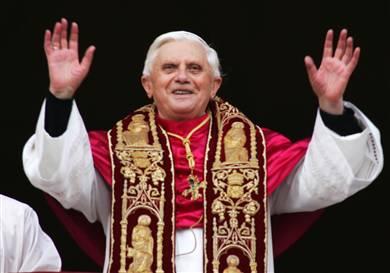
HABEMUS PAPAM!

I interrupt this homily blog with an entry about our new Holy Father, Pope Benedict XVI.

The election of Joseph Cardinal Ratzinger as the 264th Successor of St. Peter has orthodox Catholics rejoicing, and has driven the heterodox among us (not surprisingly) into a state of apoplexy!

May the Lord deliver them from their distress by changing their hearts.

Before the Cardinals gathered in Conclave, I wrote the following letter to our local newspaper, the Westerly Sun:

Now that Pope John Paul II has been laid to rest, speculation abounds concerning his successor.

Typically the pundits in the secular media offer the following comment in the midst of their reporting on the matter:

“According to recent polls, most Catholics want the new pope to be more liberal on social issues. They think he needs to change Church teaching on abortion, contraception, embryonic stem-cell research, women priests, etc.”

It needs to be made clear in this context that the pope is not a social innovator: he’s a guardian and a teacher! He is commissioned by Jesus Christ to guard the rich deposit of faith which has been faithfully handed down to him from the apostles themselves.

If he were to do otherwise (that is to say, if he were to change or modify any dogmatic teaching of the Church), he would invite upon himself the curse of Galatians 1! In that text St. Paul writes, “If we, or an angel from heaven, should preach to you a gospel not in accord with the one we delivered to you, let a curse be upon him! I repeat what I have just said: if anyone preaches a gospel to you other than the one you received, let a curse be upon him!”

May God bless the Church with a new pope who will preach and witness to the truth as faithfully as did John Paul II, the man many of us now refer to as “John Paul the Great!”

Today I want to praise and thank the Lord for answering my prayer—which was certainly the prayer of every faithful Catholic prior to this Conclave:

Thank you, Lord, for giving us a shepherd who has served you so well in the past, and who is the living embodiment of that holy fearlessness extolled by Pope John Paul II—the John Paul who said to us so often, “Be not afraid!”

Thank you for giving us a leader who will show the skeptics within the Church that there is no contradiction between teaching the truth and acting in love.

Thank you for raising up a man who will not be afraid to condemn the moral relativism and hedonism that are fast eroding Western culture; a man who will build bridges with all people of good will; a man who will avoid the “curse” of Galatians 1, and be a powerful instrument of blessing for both the Church and the world.

Let me end this reflection with the words of Pope Benedict himself. These were spoken on October 7, 1999, at St. Peter’s Basilica, during the diaconal ordination of Fr. John Sistare and his classmates from the North American College in Rome:

“The blessed virgin teaches us what it means to be a servant. At the Annunciation she responded to God’s invitation by identifying herself as his servant and by giving herself to God’s plan, so that from her body Christ will be formed. Then, having become the Mother of God, her first action is to go in haste to serve her kinswoman, Elizabeth. Let us pray that she will intercede for you who will be ordained today so that you may follow faithfully the example of her servant-Son throughout your entire life of ordained ministry, and come one day to hear his words, “Well done, good and faithful servant…enter into the joy of your Master.” (Matthew 25:21)

Pope Benedict XVI, today we offer this prayer for you, as you begin your work among us as the Vicar of Christ!

Sunday, April 03, 2005

God’s Mercy: Unconditionally Offered, But Only Conditionally Received!

(Second Sunday of Easter (A): This homily was given on April 3, 2005 at St. Pius X Church, Westerly, R.I. Read John 20: 19-31.)

[For the audio version of this homily, click here: Second Sunday of Easter 2005]


I begin this morning with a riddle:

What is unconditionally offered, but only conditionally received?

The answer is: Mercy!

Today is Divine Mercy Sunday, designated as such by Pope John Paul II five years ago. This, incidentally, was a feast that was near and dear to the Holy Father’s heart. Hence it’s most fitting that we celebrated it this weekend—the weekend of his death.

The Divine Mercy devotion, as many of us know, began back in 1931, when a young Polish nun named Faustina Kowalska saw a vision of Jesus with two rays of light coming out of his heart. Jesus told her to have a painting produced replicating the vision, and to have it signed, “Jesus, I trust in you!”

For the next 7 years the Lord gave Faustina many other private revelations concerning his mercy. He made it clear to her during this time that his mercy is unlimited and available to everyone, even to the greatest sinners.

Or, to put it another way, he made it clear to her that his mercy is unconditionally offered.

The Lord, you see, does not offer us his mercy because we’ve been good enough, or because we’ve accomplished enough or become smart enough. He doesn’t offer us mercy because we’ve received enough A’s on our report cards!

Mercy is offered to us freely and unconditionally by God because his nature is love! As St. John tells us in the fourth chapter of his first letter, “God is love”.

And this offer of mercy is rooted in what the Lord has done for us in sending his Son into the world to die on the cross! Consequently, it’s a free and undeserved gift.

This should be obvious even from the word itself: mercy. The other day when I looked it up in the dictionary I found this definition: “Mercy is “compassion or forbearance shown especially to someone who has offended you, or to someone subject to your power.”

All of that applies to our relationship with the Lord: we are God’s creatures; we are subject to his authority and power. And our sins are infinitely offensive to him in his perfection.

But, out of sheer mercy, he offers us his forgiveness and pardon anyway.

And he offers this mercy and forgiveness to us through his Church! As Jesus said to his first priests on Easter Sunday in this text from John 20 that we heard a few moments ago: “Whose sins you forgive are forgiven them, and whose sins you retain are retained.”

St. Faustina understood all this, which is why she wrote these words in her diary: “O sinner, you must not doubt or despair, but trust in mercy, for you also can become holy.”

This means that mercy is offered

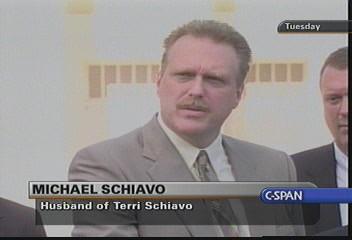
  • To people like Michael Schiavo—who murdered his own spouse.
  • To people like Brian Nichols (the man I mentioned in my Easter homily last Sunday)—who killed three people two weeks ago in a Georgia courthouse, and one more as he was making his escape.

Mercy is offered

  • To judges and politicians in this country who allow babies and sick people to be harmed and killed.
  • To priests and bishops who are silent in the face of gross moral evil.
  • To liars, cheaters, and thieves.
  • To the hedonists, materialists, and blasphemers in the modern media.

Mercy is offered to everyone, and it’s offered unconditionally—thanks be to God!

Now in some homilies on this subject that I’ve heard over the years, this is where the preacher will stop—and that’s a mistake! He will speak about God’s marvelous, unconditional offer of mercy, and that’s where he will end his reflection. But that’s wrong—that’s a grave error—because it’s only half the story.

Yes, it’s true, mercy is unconditionally offered—but it’s only conditionally received!

One of the necessary conditions, of course, for the reception of mercy is genuine personal repentance! Not simply “spoken repentance,” but rather genuine repentance.

There’s a difference, you know.

Anyone can say they’re sorry. Anyone can mouth the words. The real question is: Are they sincere?

I think we’ve all known people who have said they were sorry for something, and then later admitted that when they said the words they really didn’t mean them!

Quite frankly, I remember doing this as a child. . . .

“Raymond, say you’re sorry to your sister.”

“I’m sorry.”

But I wasn’t sorry! At least on some occasions I wasn’t! I just didn’t want to get sent to my room for the rest of the day!

Sincere repentance is different, isn’t it? Sincere repentance includes a desire not to commit the sin again (whatever it is), and the intention of bringing it to confession at the next available opportunity (if it’s a mortal sin).

St. Faustina put it this way in her diary: “[To receive mercy it is necessary] that the sinner set ajar the door of his heart, be it ever so little, to let in a ray of God’s merciful grace, and then God will do the rest.”

But that’s not the only condition that must be fulfilled to receive mercy. There’s one more that needs to be mentioned: a willingness to show mercy and forgiveness to others.

Now that really shouldn’t be news to any of us, should it?—because every time we say the Lord’s Prayer we tell God not to forgive us if we don’t forgive others.

You knew that, didn’t you?

“Forgive us our trespasses, AS WE FORGIVE THOSE WHO TRESPASS AGAINST US.”

But what if we don’t pardon—or at least make the constant effort to pardon—those who have sinned against us?

Then, in effect, we are telling the Lord when we pray the Our Father to keep us in a state of sin!

Jesus said, “If you forgive the faults of others, your heavenly Father will forgive you yours. [But] if you do not forgive others, neither will your Father forgive you.”

We need to take those words seriously.

Forgiveness, obviously, is hard for all of us. In fact, even thinking merciful thoughts about certain people can be hard for us at times.

I’ll be honest with you, I find it very, very difficult to think any merciful thoughts about Michael Schiavo, because of what he did to his innocent, helpless, disabled wife.

But I have to make the conscious effort to do it anyway! I need to pray for his conversion, and especially for his salvation (which is definitely in jeopardy at this point for his sins of murder and adultery).

We all have Michael Schiavos in our lives.

How we respond to them is crucial, because to a great extent it will determine which group we are in at the end of time.

You see, on Judgment Day, when we all stand before the throne of Almighty God, there will really be only two groups of people present: those to whom mercy was only offered, and those to whom mercy was offered and by whom it was received!

All human beings—even those who go to hell—will have experienced God’s beautiful offer of mercy; but the only ones who will actually receive it in the end and reap its eternal fruits will be those who have sincerely repented of their sins, and who have been willing to show mercy to others—even the Michael Schiavos of their lives.

May all of us, by the grace of God, end up in that second group—and experience the eternal blessings of God’s wonderful mercy.


Sunday, March 27, 2005

Ashley Smith’s Challenging Witness To The Risen Christ

Ashley Smith


(Easter 2005: This homily was given on March 27, 2005 at St. Pius X Church, Westerly, R.I.)

[For the audio version of this homily, click here: Easter 2005]


You’ve just come back from the store, and you park your car, as usual, in front of your apartment building.

As you’re getting out of your vehicle, a man suddenly approaches, holding a gun and looking desperate. He sticks the gun in your side, threatens you, and then orders you to take him to your apartment—immediately!

When you’re both inside and he takes off his hat, you recognize him as the man who allegedly killed four people in cold blood within the previous 24 hours.

What would you do in circumstances like those? What would you say?

Hopefully we will never find ourselves in that type of situation. But two weeks ago, just outside of Atlanta, 33-year-old Ashley Smith DID find herself in that situation, almost exactly as I described it.

As most of us know, the man who stuck the gun in her side that morning was Brian Nichols, a former college football linebacker, who a day earlier had allegedly killed a judge, a court reporter, and a deputy inside an Atlanta courthouse, where he was being taken to stand trial for rape. Later, as he was trying to escape from authorities, he hijacked several cars and allegedly killed a federal agent.

And now he’s a guest in your apartment—and still armed!

Most of us probably find it difficult to imagine what we would say or do, faced with such horrific circumstances—but in the case of Ashley Smith we don’t need to imagine anything, because we know for a fact what she said and what she did.

To describe it all as “extraordinary” seems grossly inadequate—but for lack of a better term that’s clearly what it was: extraordinary! A police officer in Gwinnett County Georgia perhaps said it best: “[Ashley Smith] acted very cool and levelheaded. We don’t normally see that in our profession. It was an absolutely best-case scenario that happened, a complete opposite of what you expected to happen. We were prepared for the worst and got the best.”

Because of Ashley Smith’s words and actions, it’s very likely that many more lives were saved—including her own!

Now if you followed the news a few weeks ago you know the incredible details of the rest of the story: After they entered Ashley’s apartment, Nichols first tied her up and took a shower. Then he began to talk to her. During their conversation, Ashley told Nichols that her husband had died in her arms 4 years ago after being stabbed; she also told him that if he killed her, her 5 year-old daughter would be an orphan.

Then she asked if she could read to pass the time. Thankfully, he said Yes. So she went into her bedroom, and grabbed hold of two books: the Bible, and a Christian book of practical wisdom by Rick Warren entitled, The Purpose-Driven Life.

He asked her to read to him, so she began with chapter 33 of The Purpose Driven Life (that, providentially, is where she had previously left off in the book). At the very beginning of that chapter, Rick Warren writes: “We serve God by serving others. The world defines greatness in terms of power, possessions, prestige and position. If you can demand service from others, you’ve arrived. In our self-serving culture with its me-first mentality, acting like a servant is not popular.”

That line struck a cord in Nichols, a man who had flaunted his power during the previous 24 hours and used it to kill four innocent people. The biblical philosophy Rick Warren expressed in that one line from chapter 33 was the antithesis of the philosophy Brian Nichols had been living by—perhaps all his life.

From there, Ashley went on to speak to Nichols about God, family, and the crimes he had committed. She asked him to think of the families of the victims he had shot and how they were feeling. She also helped Nichols to see that there was hope for him—even now—even after all he had done—but that he needed to turn himself in and stop the killing for that hope to be realized.

With incredible courage she said to him: “You know, your miracle could be that you need to . . . be caught for this. You need to go to prison and you need to share the Word of God with them, with all the prisoners there.”

Amazingly, 7 hours later, Brian Nichols let Ashley Smith leave so that she could go and pick up her daughter. While en route, she called 911, and a SWAT team quickly surrounded her apartment.

Nichols responded—thankfully—by waving a white piece of cloth to signal his surrender, and he was taken into custody without further incident.

This morning we gather in faith to celebrate the resurrection of Jesus Christ from the dead. In today’s first reading from Acts 10 St. Peter says, “We are witnesses of all that [Jesus] did both in the country of the Jews and in Jerusalem. They put him to death by hanging him on a tree. [But] this man God raised on the third day and granted that he be visible, not to all the people, but to us, the witnesses chosen by God in advance, who ate and drank with him after he rose from the dead. He commissioned us to preach to the people and testify that he is the one appointed by God as judge of the living and the dead.”

First and foremost, we know about the resurrection of Jesus Christ and we believe in it because of the witness of Peter, James, John and those other apostles. Theirs is the primary testimony. But we also believe—at least I do—in the resurrection of Jesus because of what I would call the secondary testimony of people like Ashley Smith!

I don’t know about you, but I look at a woman like this and I say, “How did she do it, except by the power of the risen Christ—the risen Christ she believes in?”

How did she keep from panicking? How did she exhibit such incredible courage and wisdom when her life was on the line? And most of all, how did she demonstrate compassion and love for her ENEMY—a man who was prepared (at least early on) to kill her and thus separate her from the person she loved most on this earth, namely, her daughter?

By what power was she able to overcome her normal human emotions and do these things?

CERTAINLY NOT BY THE POWER OF A DEAD MAN!

IT COULD ONLY BE THROUGH THE POWER OF SOMEONE WHO IS ALIVE!


And so, in her own unique way, Ashley Smith testified to the world 2 weeks ago that Jesus Christ has been raised from the dead and is with us always (as Scripture says) until the end of the world!

God, believe it or not, expects the same from you and from me. He expects each of us, in our own unique circumstances, to show others that his Son is alive. We are to do that by the way we speak, by the way we act, and by the way we interact with others.

And we all have the potential to fulfill this mandate and be this kind of witness in the future, regardless of what our past has been like.

Think again of Ashley Smith. You know, from what I’ve read in the last few days it’s pretty clear to me that this woman didn’t always take her Christian faith as seriously as she does now. There’s been a big change in her life. As a teenager, for example, she was arrested for shoplifting; later she got into trouble with the law for speeding and drunken driving and even battery!

In one recent interview, Ashley’s grandfather talked about his granddaughter’s difficult past, but he said the family always hoped that her good upbringing would eventually lead to positive changes in her life! That upbringing, not coincidentally, included being raised in a church community and attending services every Sunday. And this, her grandfather believes, influenced how Ashley handled herself when she was taken hostage. As he put it (and here I quote): “It was almost like she was recalling all these things she learned as a child.”

Ashley Smith had a foundation of faith in her life—a foundation that literally made a life-and-death difference in a very difficult situation. (Please hear that, you parents who tell your children you’re “too busy” to bring them to Mass every Sunday. Know that you are depriving them of that foundation!)

But it’s also clear that Ashley Smith has been personalizing her faith recently, deepening her conversion, and striving to grow in her relationship with the risen Lord. That’s no doubt why she was reading The Purpose-Driven Life and the Bible in her spare time, as opposed to the latest trashy novels or the latest issue of Cosmopolitan. And that’s why she was able to touch the mind and heart of a hardened criminal like Brian Nichols!

My point is that if Ashley Smith can change and become a good witness for the Lord, then so can we, regardless of our spiritual condition at the present moment. In fact, for some of us, a simple stroll into a reconciliation room is really all that we need to turn us around and get us headed in the right direction.

Jesus Christ died and rose from the dead so that the gates of heaven would be opened and so that we could live with him forever. He died and rose, that we might share his resurrected life for all eternity.

But we only receive the fullness of that resurrected life in the future if we witness to it NOW, by living a life faithful to our Baptism.

Lord Jesus, risen and glorious Savior, we ask you on this Easter Sunday to bless Ashley Smith in a special way for the incredible witness she gave to the world two weeks ago. We thank you for filling her with the wisdom and courage she needed to love her enemy and share the truth with him. We ask you now to give her the grace that she needs to continue her witness to your risen life. And please, Lord Jesus, give to each and every one of us that very same grace, so that someday we will all share in the fullness of your risen life. Amen.