Thursday, April 27, 2006

Which Gospels Do You Want—The Four In The Bible, Or The Ones Written By The Gnostics?

The National Geographic Society's exhibit in Washington, which contains artifacts of the Gnostic Gospel of Judas.

(Third Sunday of Easter (B): This homily was given on April 30, 2006 at St. Pius X Church, Westerly, R.I., by Fr. Raymond Suriani. Read 1 John 2:1-5a; Luke 24: 35-48.)

[For the audio version of this homily, click here: Third Sunday of Easter 2006]


Which gospels do you want? Which gospels do you want to use as the basis of your religious beliefs?

The ones that were inspired by the Holy Spirit? The ones that were written in the first century by the 4 men whose images adorn the back wall of our sanctuary: Matthew, Mark, Luke and John?

Or the ones that were written much later, by the so-called “Gnostics”? I’m talking here about writings like the Gospel of Judas (which has been in the news quite a bit recently); the Gospel of Thomas (made famous several years ago in the movie, Stigmata); the Gospel of Peter; and the Gospel of Philip. (Now please don’t be fooled: these Gnostic gospels weren’t actually written by the apostles themselves. Rather, Gnostic authors put the names of the apostles on their writings in order to deceive real Christians and lead them away from the true faith.)

At this time, let me say a brief word on Gnosticism itself, since people today are still buying into it! Case in point: Dan Brown, much celebrated author of The DaVinci Code. I hope you realize, all the so-called “deep insights” about Jesus and Christianity that he shares in this book are nothing more than ideas he ripped off from ancient Gnostic writings! They’re not new truths; they’re simply old lies!

The name itself—Gnosticism—comes from a Greek word (gnosis) meaning “knowledge”. Gnostics were people who considered themselves to be “in the know” with respect to the deep mysteries of God and the universe. They thought they were smarter and more spiritually enlightened than everyone else—which is one reason why the philosophy is still very popular today. In our pride, we like to think we know spiritual secrets that “ordinary men and women” don’t know.

In the early centuries of Christianity, the followers of Gnosticism were a lot like people in the contemporary New Age Movement. That is to say, they weren’t members of one single organization. Rather, they were people from many different groups who embraced similar ideas about life, God and salvation.

For example, the Gnostics did not believe that Jesus Christ was truly human (as genuine Christians did). To them, his humanity was merely an illusion. Consequently, in their view, Jesus did not experience death on the cross. He only appeared to die. As one author put it, his crucifixion was really a “cruci-fiction”.

Nor did they believe that Jesus was God, the Second Person of the Blessed Trinity. To them he was an “aeon”—a created being who was on a level somewhere between God and humans.

Gnostics sometimes disagreed among themselves on particular issues, but nearly all of them agreed on this crucial point: physical matter is evil (and that includes the human body), but the human soul or spirit is good.

This explains why, in the Gospel of Judas, Judas is considered a hero for helping to get Jesus killed! As most newspaper articles mentioned a few weeks ago, in the Gospel of Judas Jesus says to his betrayer, “But you will exceed all [the others]. For you will sacrifice the man that clothes me.”

In other words, “Judas, by betraying me and getting me crucified you’ll be doing me a really big favor! You’ll be helping me to get rid of this evil body that I have. You’ll help to set my spirit free from this flesh that holds it in bondage.”

Now, when you stop and think about it, you have to admit, there’s something rather appealing about this particular Gnostic teaching. You see, if your body is truly bad, then it obviously doesn’t matter what you do with it. You can get drunk every day; you can have any kind of sex you want as often as you wish. When it comes to your flesh there are no rules you have to follow!

Sounds rather tempting, does it not? That’s why people like Dan Brown think it’s great!

This, of course, is exactly the opposite of what Matthew, Mark, Luke and John teach in their gospels. They teach that matter is good, not evil. In John 3:16, for example, Jesus doesn’t say, “For God so hated the world”; he says, “For God so loved the world.”

God doesn’t hate the material universe or consider it to be evil. After all, he’s the one who made it!

And he made it a moral universe, governed by laws and commandments. St. John says in today’s second reading, “Those who say, ‘I know [the Lord],’ but do not keep his commandments are liars, and the truth is not in them. But whoever keeps his word, the love of God is truly perfected in him.”

A staunch Gnostic of the first century would wretch at a statement like that.

Following the teaching of the real gospels is obviously much more difficult than following the teachings of Gnosticism, because it requires discipline, repentance and sacrifice. But, in the long run, it’s really much better. Trust me. Because if “matter” is really as bad as the Gnostics said it was (and as some contemporary New Agers still say it is), then it becomes almost impossible to argue against evils like the Holocaust and the terrorist attacks of 9/11!

You see, according to strict Gnostic principles, the Nazis did those 6 million Jews a big favor during the Second World War by setting them free from their evil bodies! Thus, they weren’t murderers; they were liberators! They did for the Jews (and for many others) what Judas did for Jesus (according to the Gospel of Judas).

The terrorists did the same for those who died in the World Trade Center on September 11, 2001.

Do we really want to say that? Do we really want to rewrite history and call both the Nazis and the terrorists of 9/11 “liberators”?

I hope not. But we would be forced to, if we believed the Gnostic gospels. We would even be forced to say that suicide is morally good, since the person who takes his own life frees himself from his own evil body.

The real Jesus took on human flesh out of love, and he redeemed it through his resurrection. That’s the Good News! Jesus didn’t just come to save our souls from eternal death; he came to save “all” of us—body and soul—from eternal death! At 49 years of age, incidentally, that’s a thought that appeals to me more and more. I like the thought of getting back my thinning hair and my dark beard. I like the thought of having a transformed, glorified body without any middle-age aches and pains in it!

Notice in today’s resurrection story from Luke 24 how determined Jesus is to get his disciples to understand that his resurrected body is real! Even though he doesn’t need to eat (because his body is immortal), he does so anyway. He has a nice fish meal with his apostles, and he tells them to touch his body.

The Gnostics must have freaked out when they first read this story. It must have made them sick!

That’s why they felt so compelled to write their own fictitious accounts of Jesus’ life.

There are many other things I could say about the Gnostics, but I think I’ll leave that for future homilies—especially with the release of the film, The DaVinci Code, looming on the horizon.

So which gospels do you want? Which gospels do you want to use as the basis of your religious beliefs—the 4 we have in the Bible, or the Gnostic ones?

I would tell you my personal answer to that question, but at this point I really don’t think I need to.

I’ll only say that I hope and pray that your answer is the same as mine.

Saturday, April 22, 2006

Michael Schiavo’s ‘Mercy Account’—And Ours

Michael Schiavo and Terri in November of 1990.

(Second Sunday of Easter (Divine Mercy Sunday, Year B): This homily was given on April 23, 2006, at St. Pius X Church, Westerly, R.I., by Fr. Raymond Suriani. Read 1 John 5: 1-6; John 20: 19-31.)

[For the audio version of this homily, click here: Second Sunday of Easter 2006]


Fr. Frank Pavone is the national director of Priests for Life. You see him frequently on EWTN. In March of 2005 he was also on network television quite a bit, because he was the priest who ministered to the family of Terri Schiavo, as Terri was being publicly starved to death. He was interviewed many times by reporters in the mainstream media, in the midst of what can only be described as a “national horror show.”

A couple of weeks ago Fr. Pavone released an “open letter” to Michael Schiavo, Terri’s husband, on the one year anniversary of her passing. I’m sure some of you have read it, but for the benefit of those who haven’t, I’ll read it to you now:

A year ago this week, I stood by the bedside of the woman you married and promised to love in good times and bad, in sickness and health. She was enduring a very bad time, because she hadn’t been given food or drink in nearly two weeks. And you were the one insisting that she continue to be deprived of food and water, right up to her death. I watched her face for hours on end, right up to moments before her last breath. Her death was not peaceful, nor was it beautiful. If you saw her too, and noticed what her eyes were doing, you know that to describe her last agony as peaceful is a lie.

This week, tens of millions of Americans will remember those agonizing days last year, and will scratch their heads trying to figure out why you didn’t simply let Terri’s mom, dad, and siblings take care of her, as they were willing to do. They offered you, again and again, the option to simply let them care for Terri, without asking anything of you. But you refused and continued to insist that Terri’s feeding be stopped. She had no terminal illness. She was simply a disabled woman who needed extra care that you weren’t willing to give.

I speak to you today on behalf of the tens of millions of Americans who still wonder why. I speak to you today to express their anger, their dismay, their outraged astonishment at your behavior in the midst of this tragedy. Most people will wonder about these questions in silence, but as one of only a few people who were eyewitnesses to Terri’s dehydration, I have to speak.

I have spoken to you before, not in person, but through mass media. Before Terri’s feeding tube was removed for the last time, I appealed to you with respect, asking you not to continue on the road you were pursuing, urging you to reconsider your decisions, in the light of the damage you were doing. I invited you to talk. But you did not respond.

Then, after Terri died, I called her death a killing, and I called you a murderer because you knew—as we all did—that ceasing to feed Terri would kill her. We watched, but you had the power to save her. Her life was in your hands, but you threw it away, with the willing cooperation of attorneys and judges who were as heartless as you were. Some have demanded that I apologize to you for calling you a murderer. Not only will I not apologize, I will repeat it again. Your decision to have Terri dehydrated to death was a decision to kill her. It doesn’t matter if Judge Greer said it was legal. No judge, no court, no power on earth can legitimize what you did. It makes no difference if what you did was legal in the eyes of men; it was murder in the eyes of God and of millions of your fellow Americans and countless more around the world. You are the one who owes all of us an apology.

Your actions offend us. Not only have you killed Terri and deeply wounded her family, but you have disgraced our nation, betrayed the Gospel of Jesus Christ, and undermined the principles that hold us together as a civilized society. You have offended those who struggle on a daily basis to care for loved ones who are dying, and who sometimes have to make the very legitimate decision to discontinue futile treatment. You have offended them by trying to confuse Terri’s circumstances with theirs. Terri’s case was not one of judging treatment to be worthless—which is sometimes the case; rather, it was about judging a life to be worthless, which is never the case.

You have made your mark on history, but sadly, it is an ugly stain. In the name of millions around the world, I call on you today to embrace a life of repentance, and to ask forgiveness from the Lord, who holds the lives of each of us in His hands.

Fr. Frank Pavone

One of the terrible “talents” we have as fallen human beings is the talent of rationalizing our evil behavior. That is to say, we can come up with some very clever reasons for doing things that are objectively reprehensible! In the 19th century, for example, some Americans tried to justify slavery by claiming that blacks were intellectually inferior to whites; the Nazis attempted to justify the Holocaust by saying that the master Aryan race needed to be purified; the people at Planned Parenthood attempted to justify abortion, when it first became legal 33 years ago, by claiming that the “cluster of cells” in the womb wasn’t really human. But then the science of genetics proved that it was human. Of course, that still didn’t stop them. At that point they simply modified their rationalization, claiming that it’s a matter of “choice” and “rights” and “freedom”.

And now, in the aftermath of Terri Schiavo’s tragic death, people are trying to legitimize the murder of the handicapped and the terminally ill by an appeal to “compassion” and “love” and “dignity”.

We human beings are a versatile and creative lot, aren’t we? In our selfishness and greed, we can rationalize just about anything!

And yet, in the midst of all this sin and rationalizing, mercy is still available—even to the worst of sinners; even to the Michael Schiavos of this world. Today, on Divine Mercy Sunday, that’s a message we all need to hear—and internalize—and pass on.

Fr. Pavone tried to pass it on to Michael Schiavo in that letter he wrote to him a few weeks ago. Granted, it’s not a very uplifting or consoling or sympathetic note. His words there are unambiguous and uncompromising! But in the end he makes it very clear to Mr. Schiavo that, in spite of all he did last year to secure his own wife’s death, he’s not beyond the hope of salvation. Mercy and redemption are still possible for him—as long as he still has breath in his lungs and blood flowing through his veins.

The same is true for all of us. And that’s very good news, because to one extent or another we ALL need mercy. Lots of it!

Thus it should come as no surprise that mercy was the last gift Jesus gave before he died, and the first gift he gave after he rose from the dead.

Did you realize that?

While hanging on the cross, he offered mercy to his murderers when he said, “Father, forgive them, they know not what they do.”

Shortly thereafter, he pardoned the good thief and said to him, “This day you will be with me in paradise.”

And then, after he rose from the dead on Easter Sunday, he appeared to his apostles in the upper room, and the first thing he did was to give them the power to forgive sins in his name. He gave them power, in other words, to be instruments and dispensers of his mercy. He said—as we heard a few moments ago in our Gospel reading—“Receive the Holy Spirit. Whose sins you forgive are forgiven them, and whose sins you retain are retained.”

Because Jesus “came . . . by blood,” as St. John reminds us in today’s second reading, we have lots of mercy available to us. In fact, we have all the mercy at our disposal that we will ever need!

It’s as if Jesus—by his passion, death and resurrection—has set up for each and every one of us a “mercy account” at his “spiritual bank”: an account that never runs out; an account that we can never exhaust no matter what we do!

Can you imagine having an account at one of our local banks that never ran out? For some of you who constantly overdraw on your checking account, it would be a dream come true!

Of course, none of that would matter if you never made a withdrawal, would it?

Having a bottomless bank account would be absolutely, positively useless, if you never took any money out of it.

And so it is with mercy.

Mercy is available to everyone—including Michael Schiavo, who murdered his own disabled wife. But that “bottomless bank account” of mercy does none of us any good, unless we access it through repentance; and, when necessary, through the sacrament of Confession.

Lord Jesus, merciful and glorious Savior, today we pray for Michael Schiavo, that he will do some much needed “spiritual banking” in the very near future. And we also pray for ourselves and for one another, that we will have the good sense to do the very same thing whenever we need to.


Sunday, April 16, 2006

Easter and Good Friday: Inseparable

(Easter 2006: This homily was given on April 16, 2006 at St. Pius X Church, Westerly, R.I., by Fr. Raymond Suriani. Read Romans 6: 3-11; John 20: 1-9.)

[For the audio version of this homily, click here: Easter 2006]


What did you do on Good Friday?

How did you commemorate the Lord’s passion and death?

What did you do to enter into the spirit of the day?

Did you do anything?

Or was it business as usual?

You might think those are strange questions to ask on Easter Sunday, but I can assure you they aren’t.

That’s because Easter only has meaning in light of what happened on Good Friday. Or to put it another way, Easter only makes sense, if we understand and appreciate the deep meaning of our Lord's passion and death.

Easter is about life and joy; Good Friday is about death and sacrifice. We want life and joy (that’s why churches tend to be filled at Easter); we don’t like death and sacrifice (which is why those same churches are relatively empty on Good Friday). But Jesus teaches us that we can’t have the former without the latter. We can’t have life—specifically eternal life—without dying to our selfishness and sin through baptism and a life of faith.

It’s impossible.

We can’t even have a fulfilling earthly life if we’re not willing to “die” and sacrifice—although many people nowadays trick themselves into thinking that they can! Of course, the irony is that they end up empty and miserable—even if they’re rich and successful in the eyes of the world.

I’ll give you one contemporary example of what I mean. The other night, as I was flipping through the channels with my TV remote (as we men love to do), I caught part of a new show on the Bravo network called, “The Real Housewives of Orange County.” Quite frankly, it made me thankful for the gift of celibacy!

This is a “reality show” that’s obviously trying to capitalize on the popularity of two other programs, “Desperate Housewives” and “Laguna Beach”.

The women in it are all rich (you don’t live in homes like they live in unless you make a 7-figure salary); they’re all relatively attractive; they all have lots of leisure time. And they’re all—to one extent or another—bored and unhappy!

Take Jo, for instance. She’s not even married to Slade, the man she’s living with (which means that this show should actually be entitled “The Real Housewives and Live-ins of Orange County”!)

Slade has two young children from two previous relationships, who are currently living with him and Jo.

Jo is upset with Slade because his devotion to her definitely isn’t total: he still goes out when he’s at work during the day and has close relationships with other young women. And Slade’s upset with Jo, because she wants to go out every night and party with her female friends, and doesn’t want to spend any quality time with his two children.

The bottom line is that neither one wants to make any serious personal sacrifices for the other. In effect, they each want a perpetual Easter without any Good Fridays. They want a loving relationship without any self-denial or personal discipline.

Well all I can say is “Good luck, Slade and Jo—because you’ll definitely need it!”

Some people were upset with Mel Gibson a couple of years ago, because in his movie, “The Passion of the Christ,” he portrayed the resurrection of Jesus only in a very brief scene at the end of the film. There Jesus stands up in the tomb on Easter Sunday, with the marks of the crucifixion on his hands, and walks out.

It’s the only reference to the resurrection that Gibson makes in the entire movie.

I think he did that for a very good reason. He understood the mindset of “Orange County” (which is the mindset of many Americans these days). He understood it because for many years he himself embraced it—and he nearly fell into despair because he did.

Mel wanted the world to understand the importance of the cross and the fact that the cross and the resurrection are connected. Yes, Jesus rose from the dead—but that was only after he offered his life in loving sacrifice for our sins!

And we needed him to do this. The fact is, you could never atone for your own sins—as I could never atone for mine! We’re finite human beings, and our actions have only relative value. We can’t possibly heal the rift between ourselves and an all-holy God who is infinite and perfect.

Only a God-man could do that. And he did—by dying for us on that cross. He was a man like us, and so he could represent us before the Father; but he was also God, which means that his sacrifice had infinite value. It made possible the forgiveness of every sin—and it made possible eternal life for every sinner!

As Isaiah the prophet put it, “By his wounds we are healed.”

This is what we celebrate today as a Church. It’s what Easter is all about.

This means that if we’re faithful to Jesus here on this earth, we have the hope of living forever with him in a life that’s far, far better than this one. And the good news is we can all be faithful in the future if we want to be, regardless of what our past has been like. In fact, for some of us, all that’s required to move from a condition of unfaithfulness to a condition of faithfulness is a simple stroll into one of those reconciliation rooms, followed by an honest, thorough confession.

I’ll conclude my homily today with a little story that shows how important it is that we leave this life in a condition of faithfulness (which is simply another way of saying ‘in the state of grace’). This story also illustrates the close connection between the suffering of Good Friday and the new life of Easter Sunday—and at the same time it makes clear just how much Jesus Christ loves each and every one of us. The story was written by C.S. Lewis, and it’s found at the very end of The Silver Chair, which is the 6th book in his Chronicles of Narnia series.

One of the good and faithful kings of Narnia, King Caspian, has died at a ripe old age. Two children from our world, Eustace and Jill, are present for his funeral. The ceremony begins, but in the middle of it—while the funeral music is still playing—Aslan, the powerful Lion who represents Jesus in these books, magically transports the children to “his country”. (It was Aslan, you will recall, who, just like Jesus, died and rose from the dead to save sinners in another book of the Narnia series, “The Lion, the Witch and the Wardrobe.”)

Aslan brings Eustace and Jill to a beautiful stream in his country, and when the children look down into the shallow water of the stream they suddenly see the dead King Caspian lying there on his back, with the water flowing over him. And they begin to weep—as does Aslan—as we all weep when someone we love dies.

But then the Lion tells Eustace to go and pluck a thorn out of a nearby thicket. At this point I’ll read from the book itself and let C.S. Lewis tell you the ending:

Eustace obeyed. The thorn was a foot long and sharp as a [sword].

“Drive it into my paw, Son of Adam,” said Aslan, holding up his right fore-paw and spreading out the great pad toward Eustace.

“Must I?” said Eustace.

“Yes,” said Aslan.

Then Eustace set his teeth and drove the thorn into the Lion’s pad. And there came out a great drop of blood, redder than all the redness that you have ever seen or imagined. And it splashed into the stream over the dead body of the King. At the same moment the doleful music stopped. And the dead King began to be changed. His white beard turned to gray, and from gray to yellow, and got shorter and vanished altogether; and his sunken cheeks grew round and fresh, and the wrinkles were smoothed, and his eyes opened, and his eyes and lips both laughed, and suddenly he leaped up and stood before them—a very young man, or a boy. (But Jill couldn’t say which, because of people having no particular ages in Aslan’s country. . . .) And he rushed to Aslan and flung his arms as far as they would go round the huge neck; and he gave Aslan the strong kisses of a King, and Aslan gave him the wild kisses of a Lion.

The blood of the savior of Narnia—that had been shed on the Stone Table many years before—had the power to raise King Caspian to eternal life.

That, of course, is a fictitious story.

But it’s based on a true one!—the one we recall today.

Lord Jesus Christ, risen and glorious Savior, help us all to BELIEVE! And help us always to LIVE like we believe!

Friday, April 14, 2006

Good Friday 2006: Outdoor Stations of the Cross

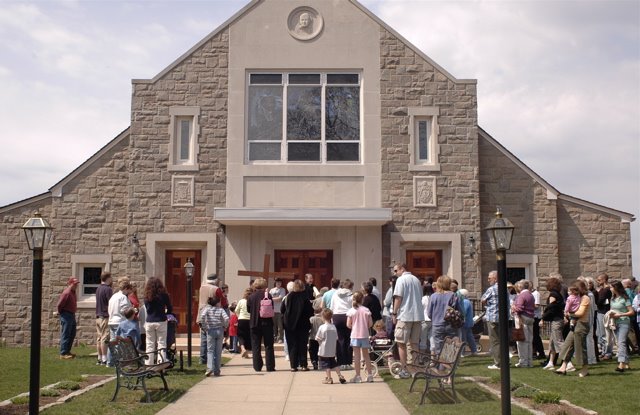
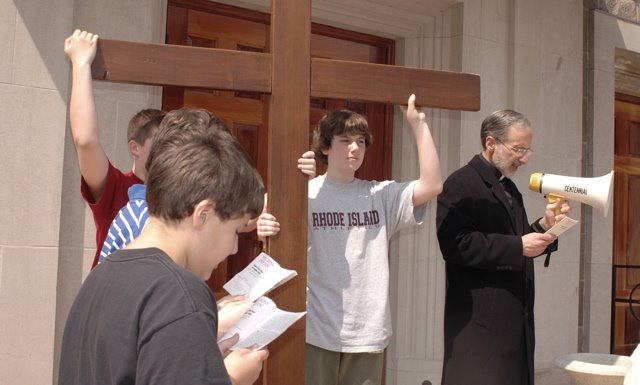
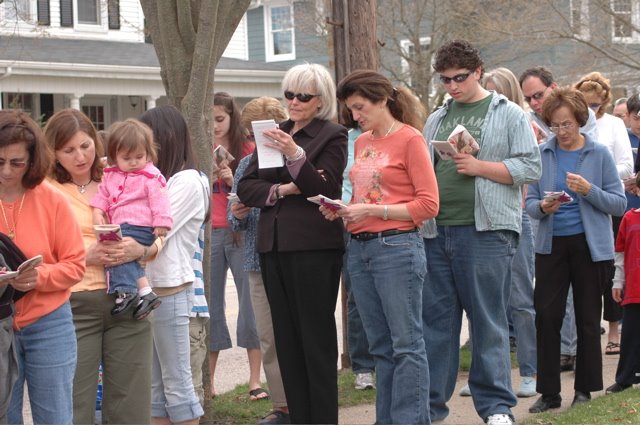
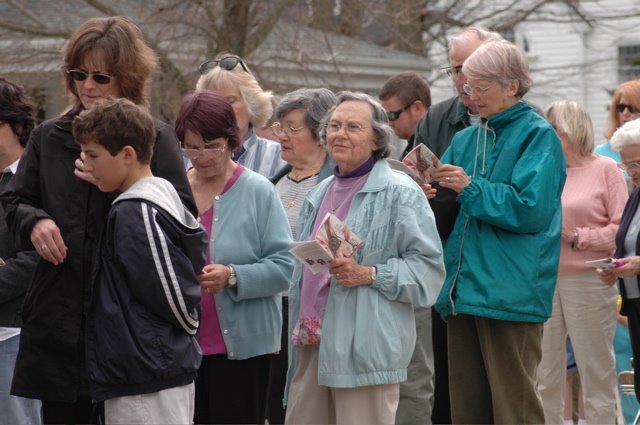
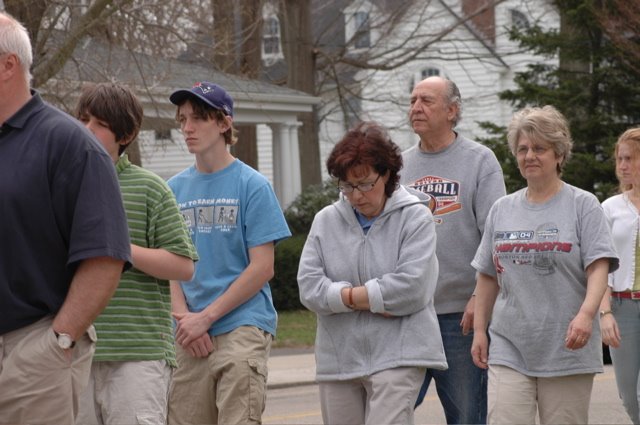
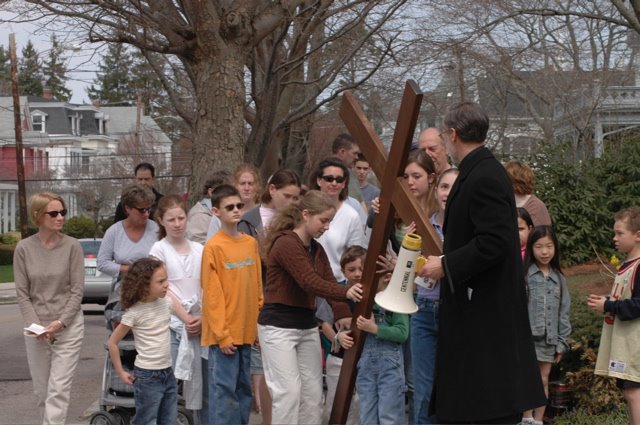
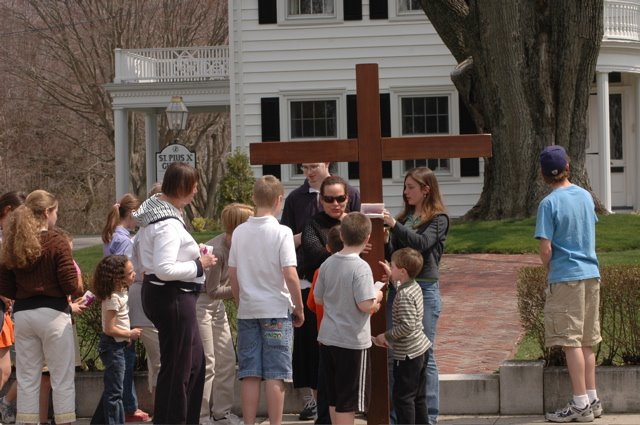
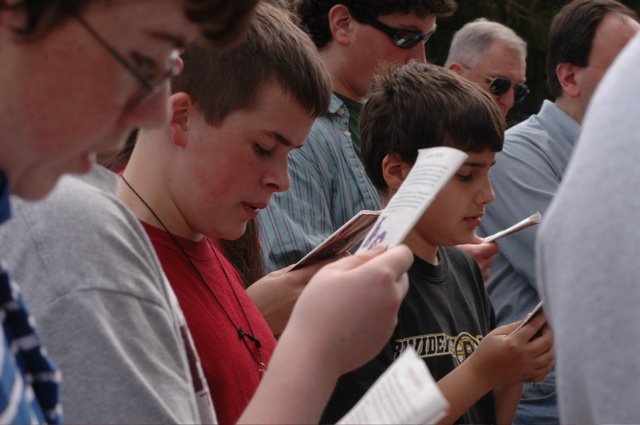
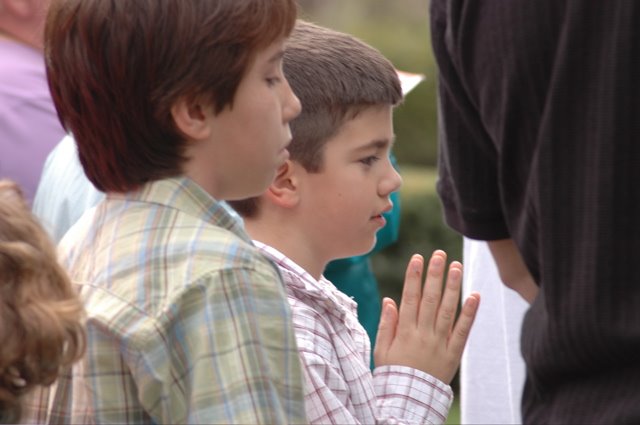
Each year, on Good Friday, we pray the Stations of the Cross at 14 locations between School and Cross Streets here in Westerly. Members of the community take turns carrying a large wooden cross.
It is an opportunity for us to give a public witness to our Catholic faith, and to meditate on the sufferings our Lord and Savior endured for us.
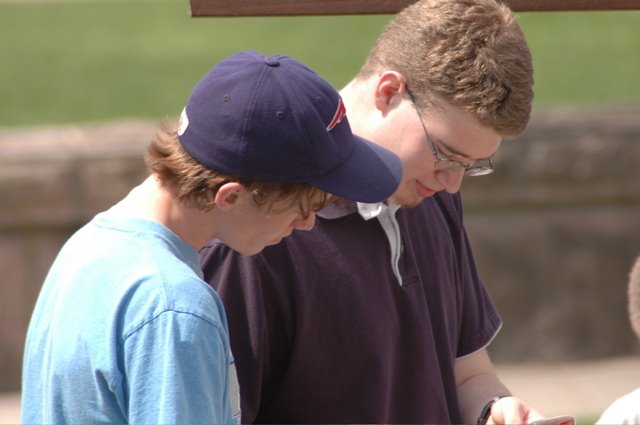
Many thanks to Elaine Chicoria for providing these great pictures from this year's event!

(Click on images to enlarge.)

We adore you, O Christ, and we praise you.
Because by your holy cross you have redeemed the world!